
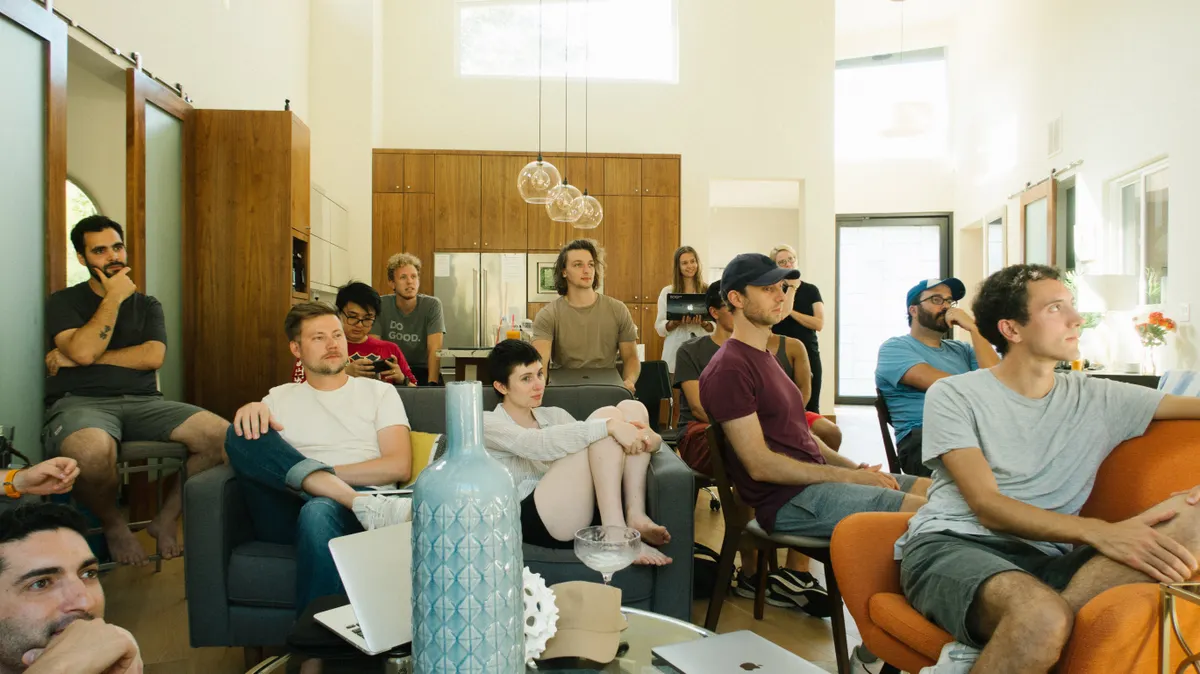

A London founder hacker house in East London is quietly making the case that you can build a serious tech company without destroying yourself in the process. Lift House, a six-person co-living and co-working space in a new waterfront development, launched in March and has gathered a small cohort of early-stage founders who journal on Sundays, play volleyball on Tuesdays, and get a full night’s sleep most nights of the week.
The pitch is deliberately understated. ‘The culture is to build something that lasts,’ said Rowan Aldean, 26, who co-founded the house with his wife Zahraa, 22. ‘Not necessarily burn out chasing a flash.’
Aldean sold a previous company last year for millions and now runs an applied AI startup focused on helping businesses deploy agents. His reference point for what Lift House should not be is vivid: he describes Bay Area hacker houses where every desk faced the wall, heads-down, with a side order of ecosystem gossip that could quietly knife you.
What Makes a London Founder Hacker House Different
The house runs on routines that would baffle a Y Combinator devotee. David Amor, 28, who runs a brain coaching business, introduced the Sunday journalling practice. Residents track time spent in nature, sleep quality, and exercise. Luke, 27, who asked that his surname be withheld and who runs an AI-marketing company, says he now eats lunch every day, which apparently needed a communal living arrangement to become a habit.
Amor is up at 8am and gives himself exactly 30 seconds after waking before starting work. He takes a cold shower afterwards, citing a 250% dopamine boost as motivation. Aldean rarely surfaces before 10am unless an investor call demands it. The house has a volleyball team in a local league and a piano in the living room. Presence Plumb, 25, a tech strategist, hosts rooftop dinners serving dishes from Iraqi to Spanish cuisine, with founders, researchers, and investors in attendance.
The contrast with San Francisco is the point. Lift House is part of a broader trend its residents call ‘Londonmaxxing’: using the specific advantages of the London ecosystem, rather than cosplaying Silicon Valley in a different time zone.
Those advantages are increasingly backed by real capital. London AI startups have raised $12 billion so far in 2026, out of $14.7 billion raised by all London startups, according to Dealroom. Zoom out to the last 12 months to end of Q2 2026 and Dealroom’s AI tracker places London second globally with $16.2 billion raised, behind only the Bay Area and just ahead of New York City at $15.9 billion.
The City Behind the Bet
Six London companies have raised more than $500 million in 2026, and three of them were founded by DeepMind alumni. The numbers are getting serious. Ineffable Intelligence, founded by former Google DeepMind principal research scientist David Silver, closed a $1.1 billion seed round co-led by Sequoia and Lightspeed, with participation from Nvidia, DST Global, Google, and the UK’s Sovereign AI Fund, according to CNBC. The company focuses on reinforcement learning, where AI models learn from experience rather than from human-labelled data.
Then there is Recursive Superintelligence. Tech.eu reported the final disclosed round size as $650 million, led by GV (Google’s venture arm) and Greycroft, with Nvidia and AMD participating. Sifted had earlier reported the figure as $500 million at a $4 billion valuation; Dealroom also lists it at $650 million. The company was incorporated just four months before its funding announcement in April 2026, co-founded by Tim Rocktäschel, a professor of AI at University College London and a former Google DeepMind scientist, and Richard Socher, former chief scientist at Salesforce. Meanwhile, Dealroom’s UK guide lists Isomorphic Labs’ May 2026 Series B at $2.1 billion, led by Thrive Capital.
Aldean points to DeepMind directly: ‘They’ve won Nobel prizes and built frontier innovation without any song and dance.’ It is a reasonable rebuttal to anyone who thinks hustle theatre is a prerequisite for frontier research.
One practical advantage London offers early-stage founders is the SEIS/EIS framework. Luke and his co-founder Varun, 27, largely bypassed venture capital at the seed stage by leaning on the government’s Seed Enterprise Investment Scheme. Under GOV.UK guidance, qualifying early-stage companies can raise up to £250,000 through SEIS, with investors receiving up to 50% income tax relief on investments of up to £200,000 per year, plus a capital gains tax exemption. ‘There’s people who will pay basically the same rate of tax if they give us the money versus if they pay income tax,’ Luke explained.
The tension is that London tends to be a launchpad rather than a final destination. Luke and Varun have already begun a US expansion, and neither has ruled out relocating to be closer to customers. An investor in Miami reportedly told them the same thing many American backers tell British founders: come here, or we’re not writing the cheque. ‘It’s quite a common practice,’ Luke said.
Aldean is clear-eyed about this. ‘Founders talk about London; everyone is bullish on the country until they get the opportunity to leave.’ The Lift House lease has about a year left. Whether the balance-over-burnout thesis survives first contact with a serious US term sheet is the question the house has not yet had to answer.
