
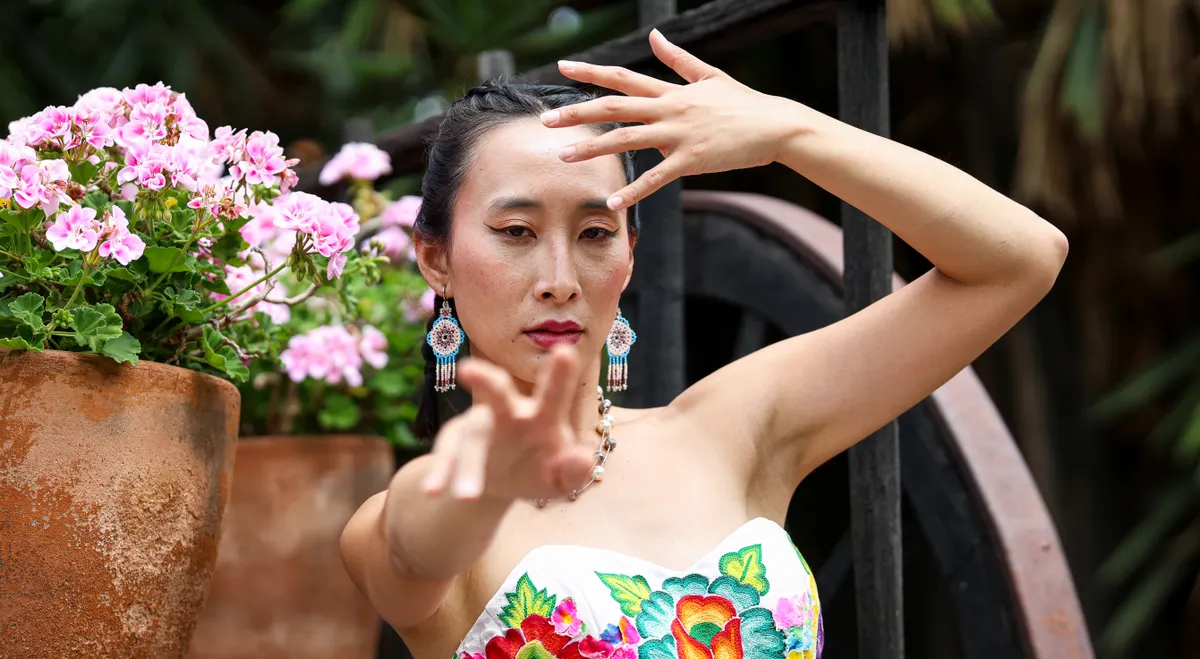

Anna Sui Spring 2027 arrived at New York Fashion Week on 12 September under the title ‘Wonderment’, and the name earns its keep. This is a collection that genuinely wants to transport you somewhere, rather than simply dress you for wherever you already are.
Romantic Layers and a Century-Old Mood Board
The Anna Sui Spring 2027 official lookbook frames the collection as an exploration of ‘enchantment and discovery through layers of romantic florals, opulent embellishment, nostalgic lingerie, lace.’ That is Sui’s language, and it fits: the show leaned hard into fantasy as a design philosophy, not just an aesthetic mood.
WWD describes the collection as mixing romantic layers with digital embroidery, which is the bit that keeps it from tipping into pure costume. The historical references are doing a lot of work here, but the production methods are thoroughly current.
Anna Sui Spring 2027 and the Art Deco Playbook
The primary historical sources, according to Vogue’s review, were the 1910s and 1920s. Specifically: parasols drawn from the pochoirs of Art Deco illustrator George Barbier, and a ‘Poiret stripe’ pyjama set that tips its hat to Paul Poiret’s radical pre-war silhouettes.
It is a well-chosen era. The 1910s and 1920s sit at the point where Western dress was being fundamentally restructured, corsetry abandoned and a new idea of the feminine body beginning to assert itself. Sui has always been fluent in subcultural and historical reference, and here she is reading from a chapter that fashion keeps returning to precisely because it never quite exhausted its possibilities.
The George Barbier connection is worth pausing on. Barbier’s pochoir prints were themselves a kind of high-fashion fantasy product: gorgeous, slightly unreal depictions of idealised leisure that circulated among the pre-war Parisian elite. Using them as a source gives ‘Wonderment’ a recursive quality, the collection dreaming of an era that was itself dreaming of elegance.
What ‘Digital Embroidery’ Actually Means for the Clothes
The mention of digital embroidery alongside all that historical romanticism is the detail that separates this from a straightforward revival exercise. Digital embroidery allows for pattern density and repetition that would be prohibitively slow by hand, which means Sui can layer the surface ornamentation more aggressively while keeping the silhouettes relatively clean.
Whether that plays out as a genuine synthesis or simply as decoration-at-scale is the kind of question a runway photograph cannot fully answer. Kendam’s show report places the presentation squarely in the context of NYFW’s broader Spring 2027 season, a week that has seen multiple designers reaching back into early 20th-century references. Sui’s version, though, has the advantage of a coherent conceptual title to organise around.
‘Wonderment’ is a word with some risk attached. Name a collection after a state of enchanted surprise and you are implicitly promising the audience will feel it. Sui’s track record suggests she is aware of the bet she is making.
The lace, the florals, the lingerie-influenced layering: none of it is unfamiliar territory for this label. The question for buyers and press heading into market appointments will be whether the digital embellishment gives those signatures enough of a contemporary edge to move them forward, or whether ‘Wonderment’ reads as a confident, prettily executed holding pattern. Early coverage suggests the former, but the shop floor will have the final word.
