
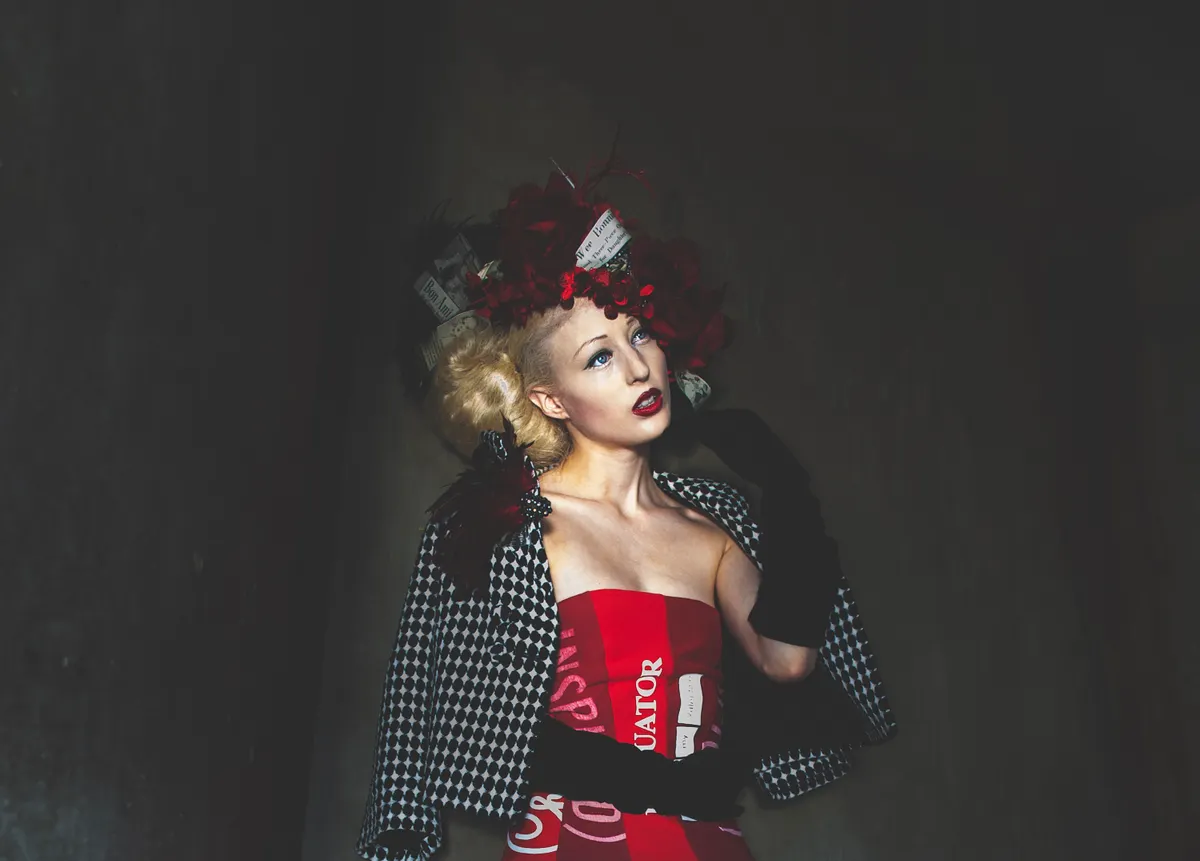

The Bad Binch TongTong Spring 2027 ready-to-wear collection landed in one of the more theatrically ambitious settings of the season: the Balloon Museum in New York’s Seaport district, where digitally flooded rooms and grassy floors dusted with paper snow set the mood before guests even found their seats.
Terrence Zhou, the conceptual designer behind Bad Binch TongTong, has always treated fashion as something closer to ritual than retail. The Spring 2027 show made that legible to anyone who walked through the door.
A Circular Room, 24 Looks, and a Past Life as a Witch Doctor
After wandering through the museum’s immersive exhibits, guests were seated in a circular room for what became a more formally structured runway experience. The collection ran to 24 looks, photographed by Umberto Fratini for Gorunway.com.
Zhou’s creative process is, by his own account, not a standard mood-board affair. He meditates daily and regularly consults psychics on the streets of New York City. One fortune teller he encountered in Chelsea told him she ‘saw my past life as some sort of witch doctor that heals people with my hands.’
You can read that as quirky designer colour, or you can take it at face value and suddenly the whole project makes more sense. Zhou isn’t building a brand so much as conducting an ongoing investigation into the self, with clothing as the medium.
Bad Binch TongTong Spring 2027 and the Industry Recognition Behind It
That investigation has attracted some institutional attention. Zhou was named the winner of the third annual CFDA / Genesis House AAPI Design + Innovation Grant, announced on 6 February 2026. He was selected from a group of finalists that included Allina Liu and Kim Shui, all of whom presented completed collections at a private event at Genesis House in New York City on 5 February 2026.
Grants of this kind tend to function as a form of early validation: a signal to stockists, press, and wholesale buyers that a young brand is worth tracking. For a label only four years old at the time of the award, it mattered.
Bad Binch TongTong was founded in 2021, according to the brand’s official press page. Zhou operates it as a fashion and art practice simultaneously, which is a distinction the Spring 2027 show did nothing to undermine. The Balloon Museum venue was not incidental set dressing; it was a statement that the work belongs in art spaces as readily as on a runway.
What the Show Actually Said
The shift from wandering through immersive rooms to sitting in a formal circular runway space was a structural choice, not just a logistical one. It asked guests to hold two modes at once: participatory and observational. That tension is pretty much the brand in a nutshell.
Zhou’s collections have always operated at the edge of wearable and conceptual. The Spring 2027 ready-to-wear outing suggests he isn’t in a hurry to resolve that tension, which is probably the right call. The brands that smooth themselves out for broader palatability tend to lose the thing that made anyone care in the first place.
24 looks, a museum venue, a past life as a healer: when the CFDA grant cycle opens again next year, Zhou’s application is presumably going to look a little different from everyone else’s.
