
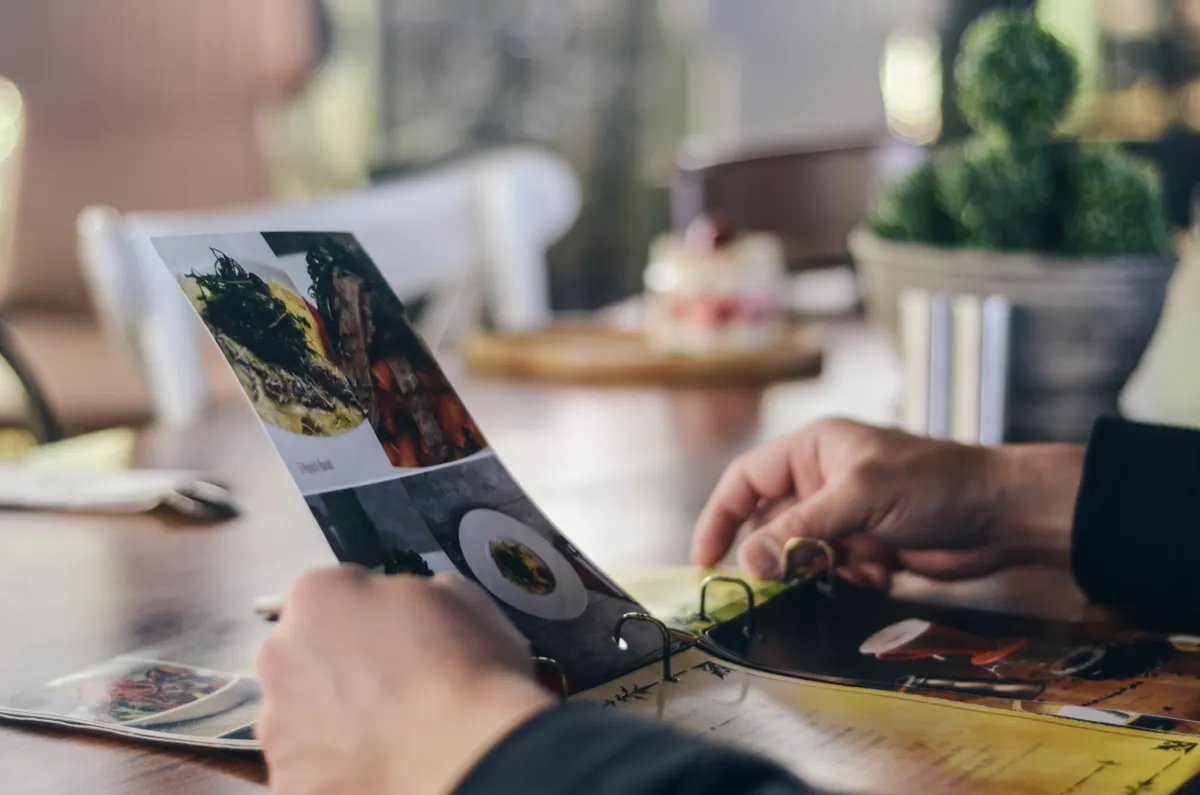

AI-generated menu images are turning up in restaurants faster than the industry has stopped to ask whether diners actually want them, and the answer, increasingly, appears to be no. The shrimp curl into themselves. The burger buns have the uncanny sheen of a prop. The ice cream is round in a way that no ice cream has ever been round in nature. You know something is wrong before you can say why.
Why AI-Generated Menu Images All Look the Same
Reality Defender CTO Alex Lisle has a tidy explanation for the aesthetic. Diffusion models and large language models learn by identifying patterns across enormous training datasets. When someone prompts one of these systems to generate a restaurant menu, the model draws on whatever menus were most prevalent in that data. ‘A lot of this stuff looks like a Chili’s menu from 2015, and there’s a reason for that,’ Lisle told TechCrunch. ‘That was the corpus of work from which [the models] drew their function.’
Popular chain menus, already sharing a house style built for maximum appetite appeal, become the baseline. The AI mimics that style and amplifies it. Every component gets smoothed toward an idealised version of itself, which is how you end up with what Lisle calls ‘Lovecraftian food horrors’: shrimp that appear to eat their own tails, cheese so bubbled it reads as abstract sculpture.
This process has a name: convergence. It sits below the more alarming threshold of model collapse, which Lisle describes as ‘almost like a mad cow disease… when you feed the outputs from one model back into itself, eventually the inbreeding becomes too much, and the whole thing collapses.’ Convergence is subtler. It degrades output quality gradually rather than catastrophically, pulling every generated image toward the same frictionless, inoffensive aesthetic.
Lee Rainie, Director of the Imagining the Digital Future Center at Elon University, frames it in terms of optimisation. ‘The optimization of the data sets is for pleasingness, or you know, not being offensive, and so there’s a way that turns into homogenization,’ he told TechCrunch. ‘What AI is known to do both in images and language is to shave off the edges.’ Rainie spent 24 years as founding Director of Pew Research Center’s internet and technology research, producing more than 850 reports on the social impact of digital technology.
The problem compounds with each edit. A user on X, posting as Labtec, demonstrated what happens when you generate a menu image in ChatGPT and then apply 100 successive edits. The food becomes progressively more abstract, more round, more cosmetically perfect, and less recognisable as something you might eat. TechCrunch replicated the experiment with similar results. Restaurants making incremental changes to AI-generated menus, swapping prices or tweaking item names, are likely accelerating this drift without realising it.
The Science Behind the Squirm
The discomfort you feel scanning these menus is not arbitrary. Researchers at the University of Duisburg-Essen, in a study published in Scientific Reports (part of the Nature portfolio) and indexed on PubMed, found that imperfect AI food images trigger a stronger uncanny valley response than images that are either clearly fake or highly realistic.
The study, which has accumulated 11 citations, involved 95 participants rating 38 AI-generated food images across a spectrum of realism. The images in the middle of that range, plausible but not quite right, produced the most disgust and unease. That is exactly the zone most restaurant AI tools are producing content in: polished enough to pass a glance, wrong enough to register on closer inspection.
Rainie puts it plainly: ‘People have an almost unexplainable sense about when they’re looking at something that’s AI-generated, compared with something that was real in the first place. There’s just a sensibility that people sometimes find hard to articulate, but they kind of know it when they see it and I think that’s one of the reasons why some of the early stories about the backlash [against restaurants using AI menus] is so pronounced.’
Lisle was named CTO of Reality Defender in July 2025, bringing more than 25 years of cybersecurity experience to the role. The company, founded in 2021 and named a Market Shaper in deepfake detection by Gartner as of June 2026, raised a $33 million Series A that counts Booz Allen’s venture capital arm among its investors, with IBM, Visa, and Comcast among its clients. Accenture Ventures has also made a strategic investment, aiming to weave Reality Defender’s deepfake detection into call centre AI and strengthen defences in financial services and media.
It is worth noting that Reality Defender profits from a world in which AI-generated content is hard to distinguish from the real thing. That does not make Lisle’s analysis wrong. It just means the company explaining the problem is also selling the cure.
The broader point Lisle makes lands harder than the menu debate might suggest. ‘Seeing and hearing has always been believing, to the point where even our court systems are entirely tuned to the idea that the gold standard in evidence is taped confessions and videotaped evidence,’ he said. ‘That’s no longer the case. The world has fundamentally shifted, for good or for ill.’ A slightly too-round scoop of ice cream is where that shift becomes visible to ordinary people. The question is whether restaurants notice the backlash before diners stop trusting the picture entirely.
