

Yushokobayashi Spring 2027 arrived at Shibuya Hikarie on 2 September 2026, and if you thought Tokyo Fashion Week had seen every possible variation on kawaii maximalism, designer Yusho Kobayashi had one more move up his lace-trimmed sleeve: a giant cardboard prawn.
The collection, titled ‘Mermaid’s Tears’, was presented on the third day of Rakuten Fashion Week Tokyo SS27, which ran from 31 August to 5 September 2026 and was organised by the Japan Fashion Week Organization. Shibuya Hikarie served as the central venue throughout.
The Little Mermaid, Retold in Lace and Live Guitar
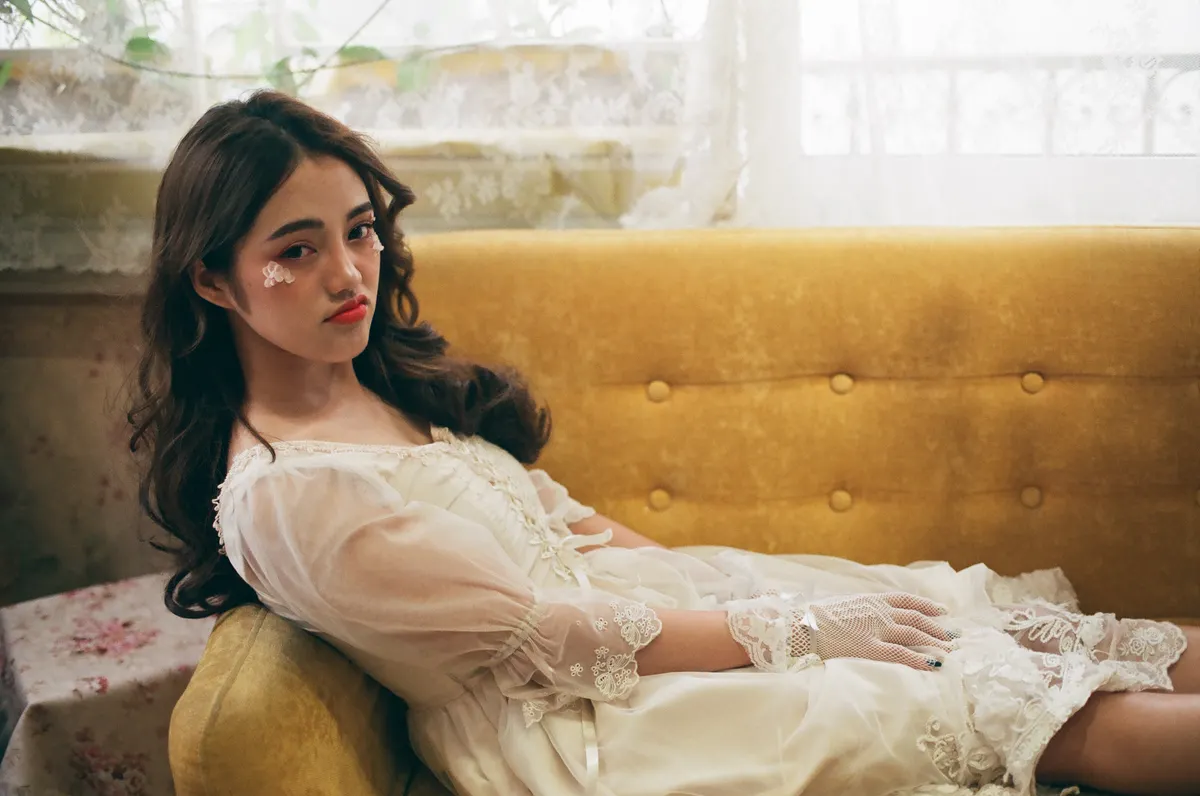
The reference point was Hans Christian Andersen by way of arts-and-crafts afternoon. Kobayashi drew from The Little Mermaid’s themes of longing, transformation, sorrow, and the price of rising to the surface, then rendered them in frilly dresses, strings of pearls, and net-like knits.
Local musician N-FENI performed a live guitar soundtrack as models walked, which gave the whole thing a slightly intimate, handmade quality that matched the clothes. The cardboard prawn, carried by one model, read less as a gag and more as the logical endpoint of a designer who described his intention as creating something ‘almost like an arts-and-crafts project,’ intricate, fun, and cute through a variety of materials.
That framing is deliberate. For Kobayashi, the creative brief isn’t ‘ocean-core’ trend-chasing. It’s a commitment to a certain texture of making: layered, fussy, tactile, and cheerfully unserious about its own preciousness.
Yushokobayashi Spring 2027 and the Brand’s Wider Proposition
Yushokobayashi was established in 2019 by Kobayashi, who has built the label around what he describes as clothing that ‘transcends age and gender,’ designed for anyone who embraces girly aesthetics and kawaii sensibility. That’s a meaningfully specific positioning: not gender-neutral in the usual minimalist sense, but actively, enthusiastically feminine in aesthetic while refusing to make gender the price of admission.
The Spring 2027 show was classified as womenswear, with photography credited to the Japan Fashion Week Organization, but the brand’s stated philosophy suggests the categories are more porous than the label implies.
Eight looks made up the collection, each building on the ‘Mermaid’s Tears’ premise in slightly different material combinations. The pearl strings reappeared across several pieces; the netting shifted in weight and density. It had the internal logic of a small label that knows exactly what it is and isn’t trying to convince you of anything else.
There is something quietly confident in that approach. Kobayashi isn’t scaling up the spectacle each season or chasing a crossover moment. The Spring 2027 collection reviewed by The Fashion Fold sits in the same register as the work before it: personal, craft-focused, and indifferent to the parts of the industry that would rather it straighten up.
Whether the cardboard prawn reads as absurdist poetry or a prop that got out of hand depends, probably, on how much patience you have for kawaii as a genuine mode of feeling rather than a marketing category. Kobayashi seems untroubled by that distinction. The collection’s title, after all, is ‘Mermaid’s Tears’: something beautiful, something slightly melancholy, and something that only exists once the creature has already chosen to leave the water.
The next question is whether the Yushokobayashi Spring 2027 aesthetic finds a retail foothold beyond the runway. The label has spent six years building its language; SS27 suggests it has no intention of simplifying it to get there faster.
