
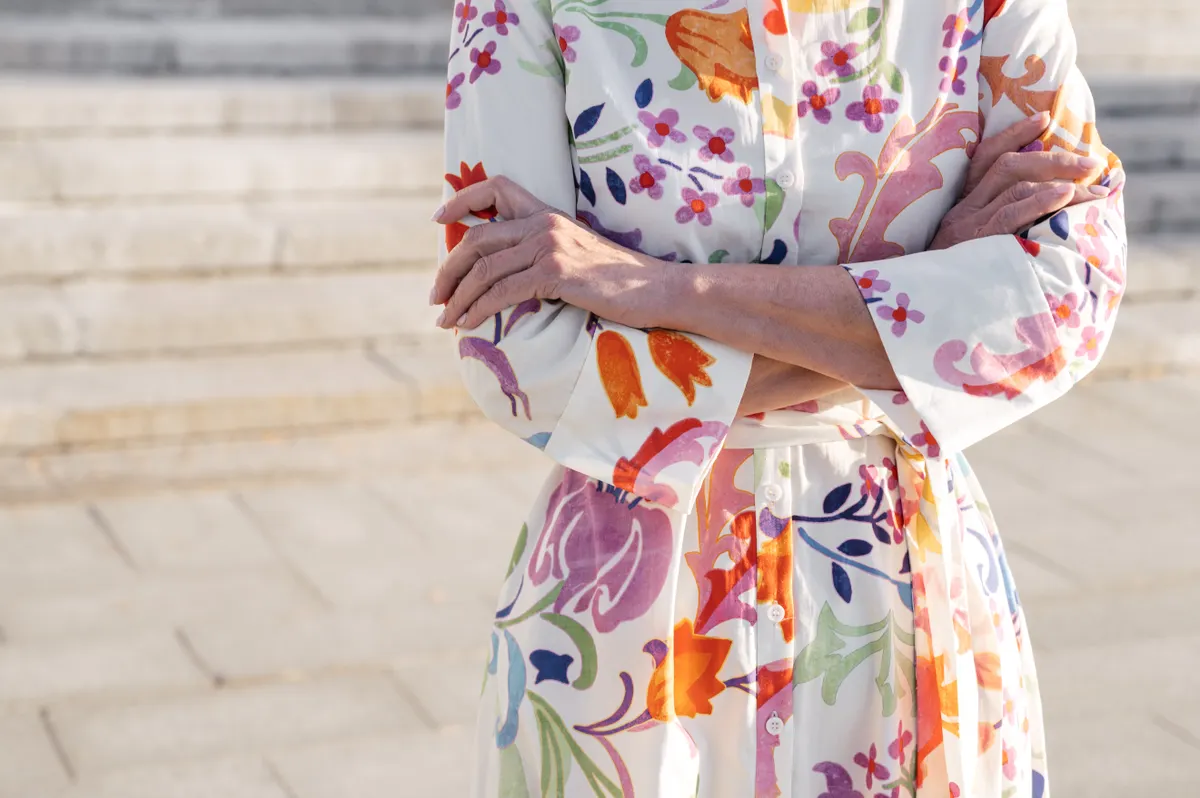

The Emilio Pucci Fall 2026 ready-to-wear collection arrives with an unlikely muse: the Palio di Siena, a medieval bareback horse race run twice a year in one of Italy’s most theatrical public squares. Creative director Camille Miceli found her way there through the house’s own archives, discovering that Emilio Pucci himself had already been borrowing from the Contrade’s heraldic iconography long before she arrived.
It’s an origin story with a certain logic. The Palio is loud, competitive, and visually extravagant. The 17 contrade of Siena, each carrying its own animal symbol and heraldic colours, send only 10 representatives to the starting line on July 2 and August 16 each year. The pageantry is fierce, graphic, and anything but understated. Pucci, in other words, fits right in.
Heraldry Translated Into Pucci’s Language
Miceli pulled the animals and emblems of the Contrade directly into prints, jewellery, and surface motifs, then pushed them somewhere more contemporary. A black-and-gold zebra print carried the drama of a heraldic creature. Other glyphs were stretched vertically or horizontally, giving familiar symbols a new sense of movement. Gold ran through the collection like a thread, lending it a nocturnal, decadent energy.
The silhouettes borrowed from the Palio’s theatrical past without costuming anyone. Waists were cinched, skirts flared, and certain dresses landed in a medieval-meets-skating register that sat naturally within Pucci’s universe. Miceli also worked from previously unused sketches by Emilio Pucci himself, extracting proportions and details from the archive rather than reproducing its most obvious references.
Winter gave her an opportunity the warmer months rarely do: tactility. Jacquards, quilting, knits, and rich surfaces made the prints feel less like decoration applied to clothes and more like part of the clothes themselves. Black-on-black jacquards and deliberately plain pieces provided counterpoints. This has become a recurring mission for Miceli: to make Pucci legible as a full fashion house, not simply an exceptional address for prints.
Emilio Pucci Fall 2026 and the Wearability Argument
Miceli has been at Pucci since her appointment as Artistic Director on September 1, 2021. Before that, she spent years working with Azzedine Alaïa, Karl Lagerfeld, and Marc Jacobs, before returning to Louis Vuitton in 2014 to oversee accessories under Nicolas Ghesquière, according to WWD. The range of that CV shows in how she handles the house: with a feel for what a garment has to do beyond looking good on a hanger.
Her stated ambition is for Pucci clothes to function as a “no-brainer”: you grab one, put it on, and go. The apparent simplicity of that idea involves more precision than it suggests. In her own framing, it requires knowing where a waist should sit, where a motif should fall, what should be revealed and what left to the imagination.
That point of view, a woman designing with actual bodies in mind rather than an idealised outline, is where her work becomes most persuasive. Pucci’s fantasy remains intact. It is just becoming more wearable.
The house itself has been through considerable structural change. LVMH acquired a 67 percent stake in Emilio Pucci in 2000, then bought out the remaining 33 percent held by the founding family to reach full ownership, at which point Laudomia Pucci stepped down after more than 20 years as vice president and image director. An LVMH SEC filing records the group’s acquisition cost at EUR 38 million, with EUR 17 million allocated specifically to the Pucci brand, fully consolidated from January 1, 2002. The house that LVMH absorbed had been built, improbably, from a career that started on Swiss ski slopes and found its first boutique in Capri in 1950. Its archive now holds more than 500 colours.
If Siena supplied the drama for this season, Studio 54 supplied the after-dark attitude. The advertising campaign, built around dancing and partying, positions Pucci firmly as an occasion brand: clothes for when you intend to be seen. Miceli is not toning anything down. She is giving all that colour, pattern, and glamour something to hold on to: stronger silhouettes, richer materials, and a little more reality beneath the exuberance.
The Palio has been running for centuries. Whether Pucci’s new chapter has similar staying power is the question Miceli’s next few collections will have to answer.
