
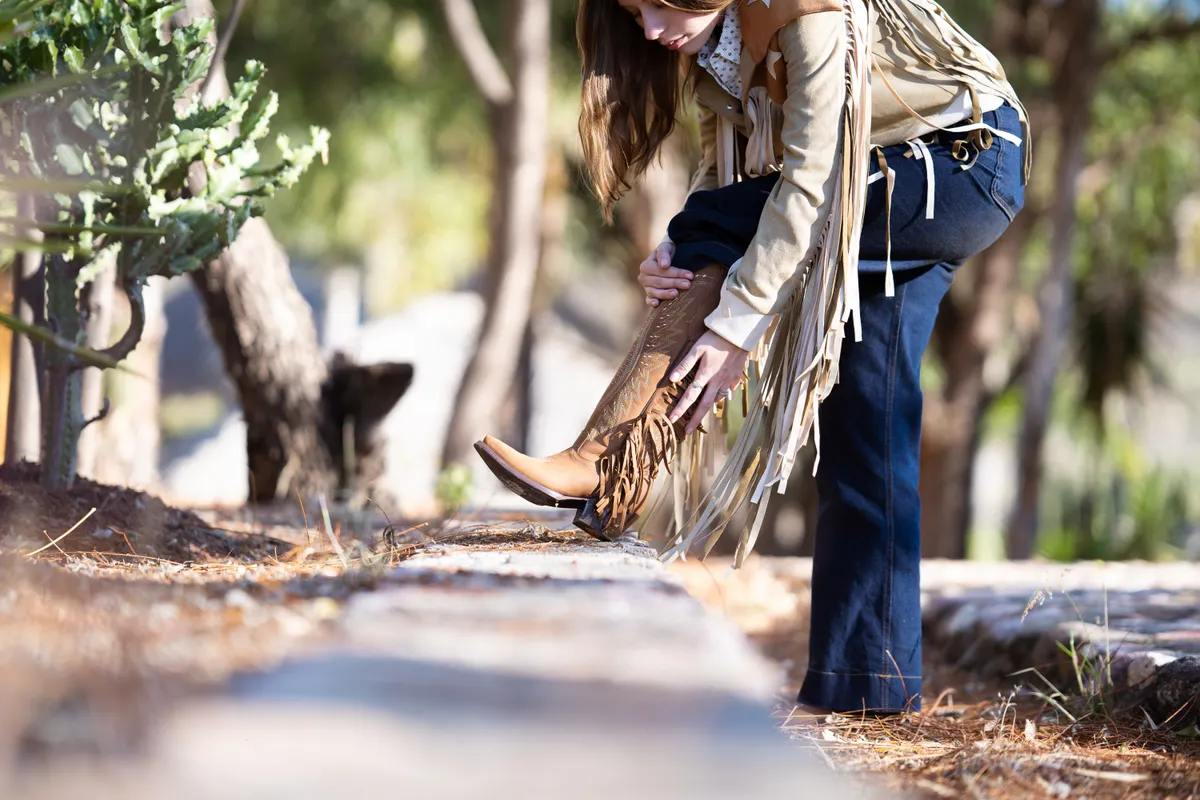

The Bode Spring 2027 collection arrives as the second chapter of a two-part story, wrapping up the Rodeo Bodeo theme that Emily Adams Bode Aujla launched last season, a theme rooted in memories of Checkers, a retired Barrel Racer and the beloved pony of her childhood. As with everything Bode does, the research runs deep, the craft runs deeper, and the clothes themselves have to carry the weight of both without requiring the customer to sit a history exam before reaching for the hanger.
A Year of Boucle and Back Issues
The label has been defined since its founding in 2016 by a commitment to storytelling, craft, and American history, with each collection built around the conservation of textiles, technique, and memory. That commitment shows up in the process: Bode Aujla and her team spent a full year working out how to handle a single boucle yarn. Their source material for this season ranged from boys’ scouting guides (the Boy Scouts of America has been producing handbooks since the early twentieth century) to the archives at the National Cowboy and Western Heritage Museum, and back issues of Frontier Times.
That last source has its own story. According to the Texas State Historical Association, Frontier Times was first published in Bandera, Texas, in October 1923, growing out of a precursor called Hunter’s Magazine that John Warren Hunter and his son launched in November 1910. The monthly contained no fiction: it was dedicated entirely to frontier history, border tragedy, and pioneer achievement, running until at least 1981. The kind of primary source, in other words, that most designers would never think to open.
‘There’s the juxtaposition of the personal narrative and the historical aspect,’ Bode Aujla explained. ‘For the first part, I was mostly drawn to a lot of images and histories around the ’20s through the ’40s. Things that I’m always inspired by, like children’s costumes, which are more like ’40s [and] ’50s, that come through again in the spring collection.’
Bode Spring 2027 Collection: What the Clothes Actually Do
All that archival weight only matters if the clothes work on the floor of a shop. Here, they largely do. The appeal is the collection’s adjacency to Westernwear and a broader country feeling: cornflower blue ginghams, rivets festooning chore jackets cut in suede or denim, and a folksy brown-and-white cow-print pony skin deployed across multiple pieces.
The smoking looks carried over from fall are styled with cummerbunds or prize ribbons, both of which happen to be trending, though Bode Aujla’s use of them feels earned rather than opportunistic. Men’s trousers are cut slightly cropped and worn without socks, a simple styling choice that lands younger and more effortless than a full break would.
The strongest pieces are the fringed leather trousers with patch pockets, a paisley jacket adapted from a Victorian capelet, and a suede skirt embroidered with cows and ropes. On the women’s side, the counterpart to the men’s tailoring is spangled tulle, pulling directly from rodeo costume references. Softer separates, shorts and button-detailed tops with a pyjama-like ease, nod to Edwardian children’s underclothes and capture something of summer’s lazier rhythm.
Bode Aujla framed the collection’s mood around ‘this idea of the American Pilgrimage West and the open range,’ and that spirit of new starts and untested possibilities reads clearly in the casting as well: the models skew young, some looking like young teens. The freshness connects to that frontier romanticism. The tension, though, is that the people who actually buy and wear Bode tend to be more mature. The brand’s imagery and its core customer have not quite aligned, and a recalibration there could open the Bode universe considerably without compromising what makes it singular.
The Bode Bode Spring 2027 collection does what the best Bode seasons manage: it makes the scholarship feel like pleasure rather than homework. Whether that pleasure converts at the till may depend on how broadly the brand is willing to imagine who its customer is.
