
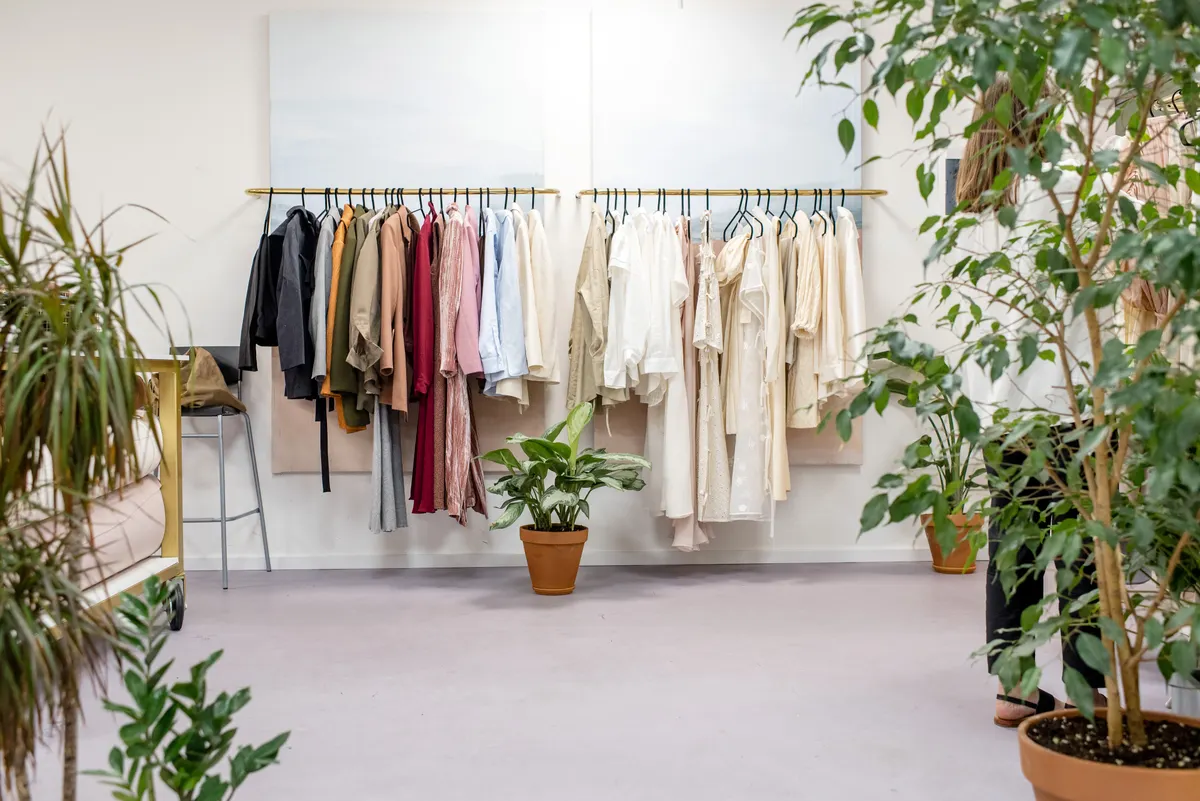

The Weldun adaptive fashion marketplace launched this autumn with a founding edit from Kallmeyer, Mansur Gavriel, Another Tomorrow, and a handful of smaller labels, positioning itself as the discovery layer that women navigating surgery, illness, pregnancy, or menopause never quite had.
The platform is the work of artist and designer Carly Berlin, whose preventative double mastectomy sent her on a months-long search for clothing that was both functional and worth actually wanting. Skims and Negative Underwear got her through recovery. Forwarding those finds to friends in similar situations got her thinking about why the search had to be so hard.
What Weldun Actually Sells
The marketplace does not limit itself to clothing purpose-built for adaptive use. Instead, it curates pieces from existing luxury ready-to-wear collections and recontextualises them across four functionality lenses: Easy On / Easy Off, Healing and Recovery, Sensory-Considered, and Flexible Fit. Shoppers can also use conventional category filters if the clinical framing puts them off.
That recontextualisation goes deeper than tagging. Berlin asks brand partners about features that never make it onto a line sheet. ‘Oh, actually there are these hidden snaps that could be functional for X, Y, and Z purposes,’ is the kind of answer she is after. H-O-R-S-E founder Sue Williamson, who was diagnosed with cancer a few years ago and has had several surgeries and treatments that altered her body and mobility at times, found the exercise clarifying: oversized sleeves designed to accommodate a port-a-cath she once had implanted in her arm were never labelled as adaptive. They just were.
‘Just because something is functional doesn’t mean that it can’t be beautiful,’ Berlin says. ‘You see that all the time in interior design, but it’s really not a part of the conversation in fashion.’
The Weldun Adaptive Fashion Marketplace and Its Failed Predecessors
The Weldun adaptive fashion marketplace is entering a sector that looks enormous on paper. The global adaptive clothing market is projected to grow from $1.53 billion in 2025 to $2.65 billion by 2033. According to Grand View Research, North America held 43.6% of global adaptive clothing revenue in 2025, with the US accounting for 56.1% of that North American share. The women’s segment is forecast to grow at a CAGR of 7.5% between 2026 and 2033. Worth noting: the same data shows the offline channel still held 67.4% of market share in 2025, a reminder that online platforms in this space are swimming against a significant distribution current.
‘Looking at the market size, this is not a niche experience,’ Berlin says. The Tilting the Lens white paper, which informs Weldun’s approach and whose underlying $2.6 trillion disposable income figure for the global disabled community draws on the Return on Disability Group’s 2024 report, makes the same argument at scale.
But the sector has chewed through would-be disruptors before. Adaptista launched in 2022 aiming to be the Farfetch of adaptive clothing, then pivoted to developing its own lines. Juniper Unlimited, backed by Global Brands Group (GBG), collapsed when its financial sponsor filed for Chapter 11 bankruptcy protection on 29 July 2021 in the Southern District of New York, disclosing between $1 billion and $10 billion in both assets and liabilities and listing between 1,000 and 5,000 creditors. The MagnaReady and JUNIPERunltd brands were among the assets listed for sale in the bankruptcy process, according to WWD, with GBG USA’s CFO stating that the company had received more than half a dozen indications of interest from potential buyers in the months before filing.
Maura Horton, who invented MagnaReady’s magnetic-closure technology, is now one of Weldun’s advisors. The irony is not particularly subtle.
The Editorial Bet
Weldun’s response to this history of short runs is not purely commercial. Alongside the marketplace, it is launching Wel Said, an editorial platform and newsletter designed to profile women and contextualise the clothing through personal narrative. The first subject for its quarterly Weldun Voices series was Gloria Steinem, who died at her New York home on 2 September, aged 93. ‘She’s obviously incredible, and embodies all of the seasons of a woman’s life at 93 years old,’ Berlin said before her passing.
KR Liu, Google’s global head of product innovation and marketing partnerships and a Weldun advisor, frames the cultural moment plainly. ‘The technology, the creative appetite, and the cultural readiness have all aligned to make a platform like Weldun not just possible, but natural,’ she says.
The advisory bench also includes Christina Mallon, director of inclusive design at Microsoft and a board member of Open Style Lab, and Sinéad Burke, founder of strategic accessibility consultancy Tilting the Lens. Both had a hand in building the platform, from website design to the language used throughout.
Berlin’s editorial theory is that this funnel reaches a customer who would never search “adaptive fashion” but would follow a well-told story about dressing through illness, surgery, or age. The ‘curated closets’ interviews, where someone recovering from shoulder surgery walks through the pieces that helped them, with links back to the marketplace, are the mechanism that makes the shopping feel personal rather than clinical.
The Runway Ahead
The Weldun adaptive fashion marketplace raised a friends-and-family round pre-launch, with a second allocation of that round committed for this autumn. Berlin is targeting the platform’s first institutional raise for the middle of 2027.
The longer plan is to use data gathered from customer behaviour to inform brand partners’ future product development: a feedback loop that, if the platform sustains itself, could do more to move mainstream fashion than any dedicated adaptive line. ‘No one has really understood this consumer, in this context, at this scale,’ Berlin says.
The graveyard of previous attempts suggests that claim will need more than a good curation engine to hold up. The institutional round in 2027 is the first hard deadline for proving it.
