
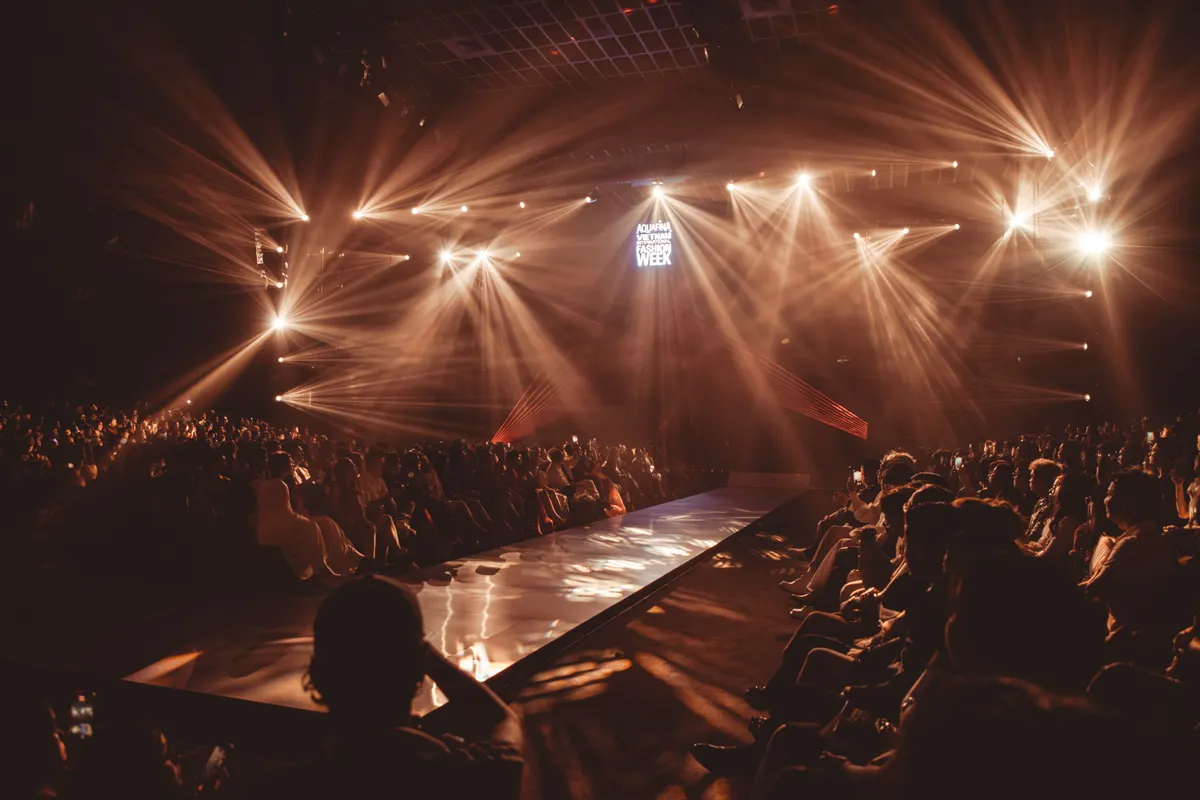

Rakuten Fashion Week Tokyo wrapped its SS27 edition with a familiar tension at its core: the designers it helped build keep leaving, and the organisation must find fresh faces to fill the gap. Only 27 shows ran across six days, with several of Tokyo’s most established domestic names opting for lookbook shoots or off-schedule presentations instead.
The off-schedule drift at Rakuten Fashion Week Tokyo
‘A lot of emerging designers now prefer to show outside of Tokyo Fashion Week timing-wise, and they are also trying to show in Paris,’ says Kaoru Imajo, director of the Japan Fashion Week Organization (JFWO). The pull is partly commercial: being closer to the men’s schedule or the pre-summer buying season in Paris makes more business sense for certain brands.
Viviano, one of the schedule’s longstanding names, skipped this season entirely and produced a lookbook instead. The brand recently hired PR in Los Angeles, and its designs have since been worn by Lady Gaga, Bad Bunny, and Hudson Williams. As the brand put it: ‘If you are a really young brand and you need attention, it’s a good thing [to show at Tokyo Fashion Week], but for us, once you reach a point, maybe it’s not as important to be on schedule.’
Knitwear label Pillings by Ryota Murakami did stay on schedule and was one of the week’s highlights, expanding beyond its signature knitwear into linen suiting and sporty separates. Shortlisted for the LVMH Prize and stocked at Dover Street Market London, New York, and Andreas Murkudis in Berlin, the brand has over 25 international stockists. Murakami will hold a showroom at Paris Fashion Week in late September, and hinted this Tokyo show may be his last in Japan for a while.
International designers fill the schedule gaps
Of the 27 slots on the schedule, nine were taken by designers from outside Japan, representing France, Spain, Thailand, Taiwan, the Philippines, Canada, and China. JFWO is leaning into this deliberately. ‘It’s a way for us to keep the week more exciting,’ says Imajo.
The Paris-based RUN x Andam showroom continued a partnership with JFWO from last season, bringing seven European designers to Tokyo. Frederic Maus, CEO of WSN Group (which operates RUN), is bullish on the Japanese market despite the weak yen making imports more expensive for local buyers. ‘Wholesale is still really strong, and so Japan is a major opportunity,’ he says. ‘The way [retailers] tell the story, that’s something I think we need to reinvent in Europe.’
Spanish designer Sonia Carrasco, who showed a deconstructed tailoring collection, does the bulk of her business in Japan. ‘They were the first market that supported me since the beginning, and they are still supporting us now,’ she says. JFWO also brought in 16 overseas guests including buyers and press from 10 Corso Como Seoul, ShowStudio, Tessabit, and FWRD.
Khoki and the week’s breakout moment
The show most people were talking about came from Khoki, a design collective building a cult following in menswear. Sponsored by Rakuten’s ByR initiative, the presentation was held in a warehouse in Tokyo Bay, with a set replicating designer Koki Abe’s family home in Yamanashi.
Khoki was a LVMH Prize 2024 semifinalist and was named one of the ’10 Asian Designers to Watch’ in 2025, according to the official Rakuten Fashion Week Tokyo SS27 report. FWRD’s buyer Luna put it plainly: ‘A lot of Khoki’s techniques and deconstruction are pretty unique for what we’re buying and seeing. I think it’s serving a nice white space that we have for our market.’
The prize announcements that will shape Tokyo’s next chapter
The week closed with two prize announcements. The Fashion Prize of Tokyo went to denim-focused label TANAKA, a unisex brand founded in New York in 2017. Co-organised by the Tokyo Metropolitan Government and JFWO, the prize will send TANAKA to Paris for showcase events in January and June 2027, plus an appearance at Rakuten Fashion Week Tokyo in March 2027.
TANAKA was previously selected as a Tokyo Fashion Award winner in 2023 and has been named a ‘Radar Designer’ by Bergdorf Goodman. Co-designer Sayori Tanaka began her career at Yohji Yamamoto before leading the women’s global design team at Fast Retailing (parent company of Uniqlo); her creative partner Akira Kuboshita, who joined the brand in 2020, previously led the men’s global design team at Uniqlo. The snippet attributed the Uniqlo role to Sayori Tanaka alone; FashionNetwork’s reporting clarifies the distinction. She relocated to the United States in 2013 and co-founded TANAKA in New York in 2017.
The Tokyo Fashion Award 2027 named eight winners: GURTWEIN, OHROHEE, POOLDE, and Takemaru in womenswear, and CIOTA, GOOD PEOPLE GOOD STITCHING GOOD PRODUCT, Midorikawa, and ORIMI in menswear. All eight receive support across four seasons (27 A/W through 29 S/S), including a joint Paris showroom during Fashion Week. The ceremony was held at Shibuya Hikarie’s Hikarie Hall on 5 September.
Among the eight, Gurtwein designer Teruhiro Hasegawa articulated something that felt like the week’s real undercurrent: ‘I’ve had customers drive three hours just to get to a different store because an item was sold out at their local shop. Hearing stories like that made me feel that rather than a large spectacle, it might be more meaningful to hold a show where there’s a form of connection between the audience and us.’ That tension between scale and intimacy is exactly what Rakuten Fashion Week Tokyo is navigating right now. The next season runs 31 August to 5 September 2026, with 28 presentations on the schedule. Whether the names on that schedule will still be around two years later is the question the JFWO hasn’t answered yet.
