

Alexander Wang‘s Fall 2026 ready-to-wear collection arrived wrapped in the aesthetic grammar of his 2010s peak: faux fur, rhinestones, tough-girl leather and a deliberate sense of not-trying-too-hard. Wang called the mood ‘extreme opulence.’ The clothes, rendered almost entirely in slate grey and black, told a slightly more complicated story.
Faux Fur, Rhinestones and the Alexander Wang Fall 2026 Aesthetic
Two materials drove the whole thing. Faux fur appeared as the lining of a jean jacket, the fat lapels of a technical khaki nylon trench, and trimmings on denim miniskirts. It also turned up as a Meret Oppenheim-esque tank top and a fluffy bra worn over a leather dress, the latter described as a personal favourite by the designer himself.
Then there were the squiggly faux fur belts, the collection’s most playful recurring motif. Cinched around imposing padded coats, they introduced a cheeky softness to otherwise hard silhouettes. The same looping, frozen-wave shape was later reimagined as the hem of a cropped high-neck sweater and a logo T-shirt. ‘It’s gestural,’ Wang said. ‘Like the attitude of tying your shirt at your waist.’
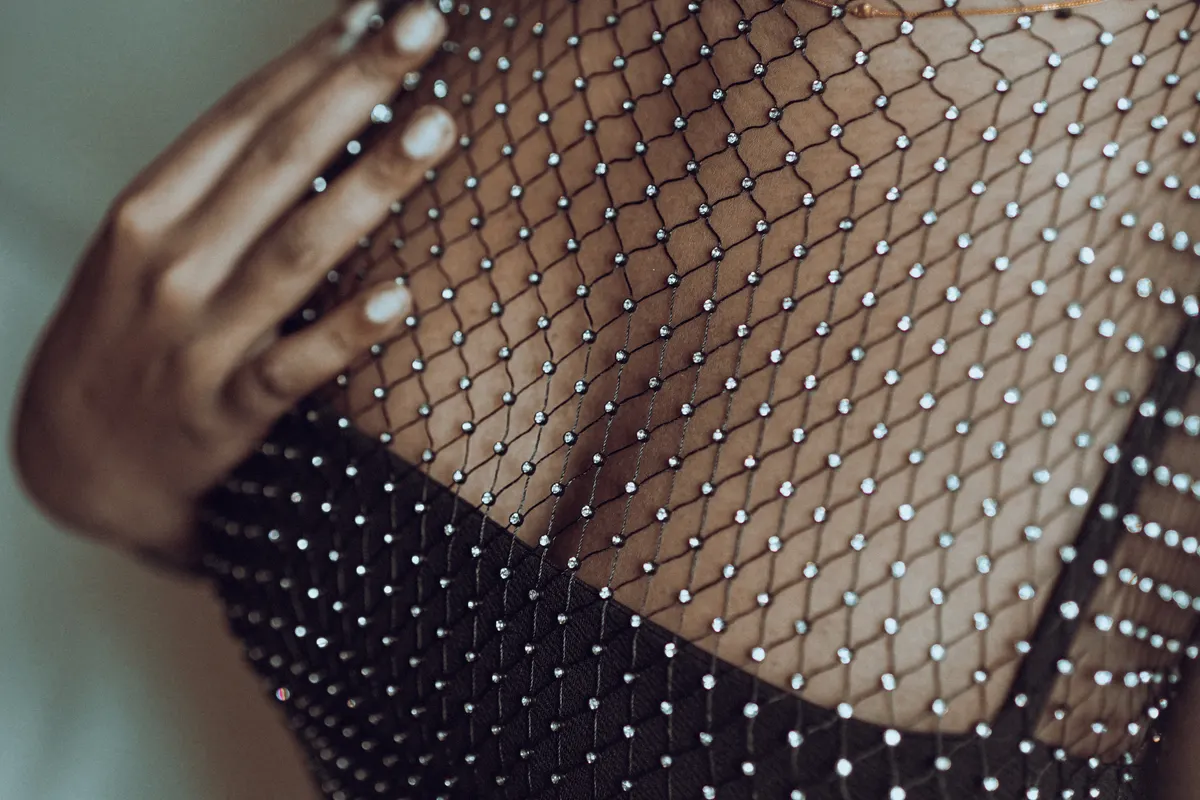
Rhinestones handled the glamour. They were splashed across body-skimming dresses in both mini and maxi cuts, many featuring a yanked-and-tied-at-the-hip detail that gave a draped, improvised look. Wang cited an image of Kate Moss leaving a party with her gown hem lifted and tied after she ripped it as partial inspiration. The same crystal details carried over to shoes and bags, with heels staying high and evening purses staying dainty and rectangular.
A quieter thread ran alongside all of this: a series of geometrically constructed, deliberately simple pieces. A long cylindrical knit maxi dress, essentially a tube with armholes and a floppy cowl neck. A slinky cape cut from one large half-circle of fabric. A little dress with a draped and folded hem produced by a continuous, donut-shaped pattern. ‘It’s just easy,’ Wang said. ‘To feel minimal and not so worked. And then we add the crystal embellishment.’
The Rocco Returns, and the Business Case Behind the Nostalgia
The most commercially loaded moment in the collection was the return of the Rocco bag, the grommeted-bottom carry-all that became shorthand for Wang’s brand in its first act. It comes back in three sizes this season and is lighter than the original. CR Fashion Book reports the relaunched bag has been rebranded as the Ricco Bag and redesigned as a unisex, rectangular style.
Wang mentioned seeing Charli XCX perform at Outside Lands and experiencing an uncanny sense of déjà vu. ‘I was like, “Oh my god, this feels so familiar,”‘ he said. The culture’s appetite for early-2010s nostalgia is real enough that leaning into it looks less like retreat and more like calculated timing.
That calculation sits against a commercial backdrop that has been moving in Wang’s favour. According to Vogue, Wang has said the brand turns over $200 million annually and has posted double-digit revenue growth and double-digit EBITDA every year since 2019. Asia accounts for 50 per cent of revenues, with the US contributing 30 per cent and Europe the remaining 20 per cent.
The brand has also taken a minority investment from two China-based entities: venture capital fund Challenjers Capital and Youngor Group, a firm whose core activities span clothes manufacturing and property development. Wang has said he projects the funding will help double the company’s revenue within five years, with plans to open three new US stores in the coming year already in place.
Wang first made his name in 2005, according to the New York Post, and the years since have included both cultural dominance and a period of considerable public difficulty. The Fall 2026 collection, fur belts and all, reads as a confident statement that the brand intends the next chapter to look like the first one, only bigger.
Three new US storefronts and a relaunched bag are the near-term tests of whether the numbers follow the aesthetic.
