
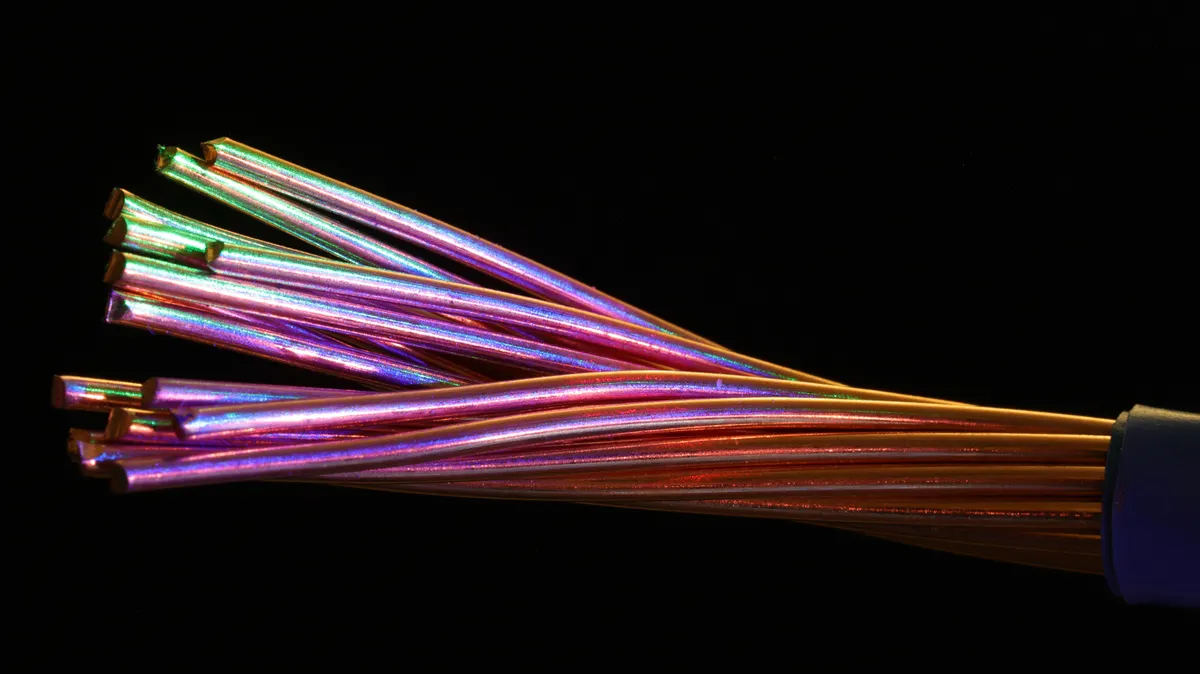

Relativity Networks has closed a $22 million raise to scale its hollow-core fiber funding push into AI data centre infrastructure. The pitch is simple, even if the physics is not: light travels faster through air than through glass, and that gap, measured in microseconds per kilometre, is starting to matter enormously.
Hollow-Core Fiber Funding and the Scale Problem
Where conventional fibre-optic cable transmits light through glass, hollow-core fibre routes it through a vacuum chamber at the centre of the line. The result, according to CEO Jason Eichenholz (spelled ‘Eisenholz’ in some early coverage, but ‘Eichenholz’ in the company’s own PR Newswire press release and in Data Center Dynamics), is a signal that travels at roughly 3.5 microseconds per kilometre, down from about 5 microseconds in glass fibre. A 30% reduction in latency.
For a single rack of GPUs, that difference was irrelevant. As AI compute has sprawled across campus-scale deployments spanning hundreds of acres and dozens of buildings, it has become a real constraint on how far apart processing nodes can sit before synchronisation breaks down.
The practical upshot, per the company’s own data: conventional fibre limits co-operating data centres to within roughly 60 kilometres (37 miles) of each other before latency becomes a serious problem. Hollow-core fibre extends that range to 90 kilometres (56 miles), a 50% increase in viable operating distance. Eichenholz frames it as giving developers 30% more geography before latency turns into a blocker.
‘The largest systems are distributing the compute across multiple campuses to reach the power that exists,’ he told TechCrunch. ‘They’re moving to where the warm shell is, but they still need to operate as one synchronized machine.’
Manufacturing at Scale, With a Large Partner Already On Board
The hollow-core fiber funding round arrives after a $6 million seed that brought Relativity’s total prior financing to $10.6 million. Closing $22 million on top of that is a meaningful step up, but the more operationally consequential detail is the co-manufacturing arrangement already in place with Prysmian Group, one of the world’s largest cable producers.
Prysmian’s executive vice president of digital solutions, Frederick Persson, has said: ‘Our work together plays an essential role in bringing hollow core fiber to market at scale through our global co-manufacturing expertise.’ High-volume production is the part of this story that tends to get less attention than the physics. Hollow-core fibre has been around as a concept for years; the difficulty has always been making it cheaply enough, consistently enough, to actually deploy.
Demand signals suggest the urgency is real. According to Relativity Networks’ own press coverage page, citing a January 2026 Fierce Network report, AWS reportedly wants more hollow-core fibre than it can currently obtain, with hyperscale demand running ahead of available supply. Eichenholz has also pointed to AI driving a 165% increase in data centre power demand, per Laser Focus World, as the structural force behind that appetite. More power, more compute, more distance to manage.
The technology itself was developed in collaboration with the College of Optics and Photonics at the University of Central Florida, which at least grounds the science in something other than a pitch deck. Prysmian’s involvement gives it a route to manufacturing credibility. In September 2025, Relativity also announced a strategic partnership with UK-based Network Planning Solutions to accelerate deployments outside North America.
Eichenholz has a broader thesis about where this sits in the arc of AI infrastructure. The first era, as he tells it, was about stacking GPUs. The second was about optimising the networking fabric between them. The third, he argues, is about the geography: where physical hardware can actually be placed, and how far apart those locations can be while still operating as a coherent system. Hollow-core fibre, in that framing, is less a niche cable upgrade and more a constraint on the entire build-out map.
Scepticism is fair. The gap between ‘can extend range by 50%’ and ‘changes where data centres are built’ is considerable, and it will be filled, or not, by procurement decisions at hyperscalers who have their own infrastructure playbooks. The AWS supply-demand signal is encouraging, but anecdotal. Whether Prysmian’s co-manufacturing capacity can keep pace with that demand is the variable that actually matters now that the funding is in place.
