

Oratomic quantum computing funding has reached $300 million in a Series A round, as the Pasadena-based startup argues it can build a fully fault-tolerant quantum computer with a fraction of the qubits rivals say they need. The round was co-led by ARCH Venture Partners, Spark Capital, and Khosla Ventures, with a broad slate of additional backers.
The 20,000-Qubit Claim at the Heart of Oratomic Quantum Computing
The pitch is deceptively simple: most quantum roadmaps assume you need roughly a million qubits to do anything genuinely useful. Caltech’s own newsroom confirms the new research suggests that figure could be as low as 10,000 to 20,000 qubits, with a fully realised machine potentially operational by the end of the decade.
That gap, from a million down to 20,000, is not a rounding error. According to Oratomic’s launch announcement, the company’s breakthrough research indicates 10,000 reconfigurable atomic qubits may be sufficient for cryptographically relevant quantum computation. That is the kind of claim that either reframes the entire industry or ages very badly.
Co-founder and CEO Dolev Bluvstein, in remarks reported by TechCrunch, put it plainly: ‘You would have not previously been able to convince any of us to start a quantum computing company, because we just thought it was way too far away. Only when we made this recent breakthrough did we simultaneously all change our minds.’
Optical Tweezers and a Hardware Approach Built to Skip the Queue
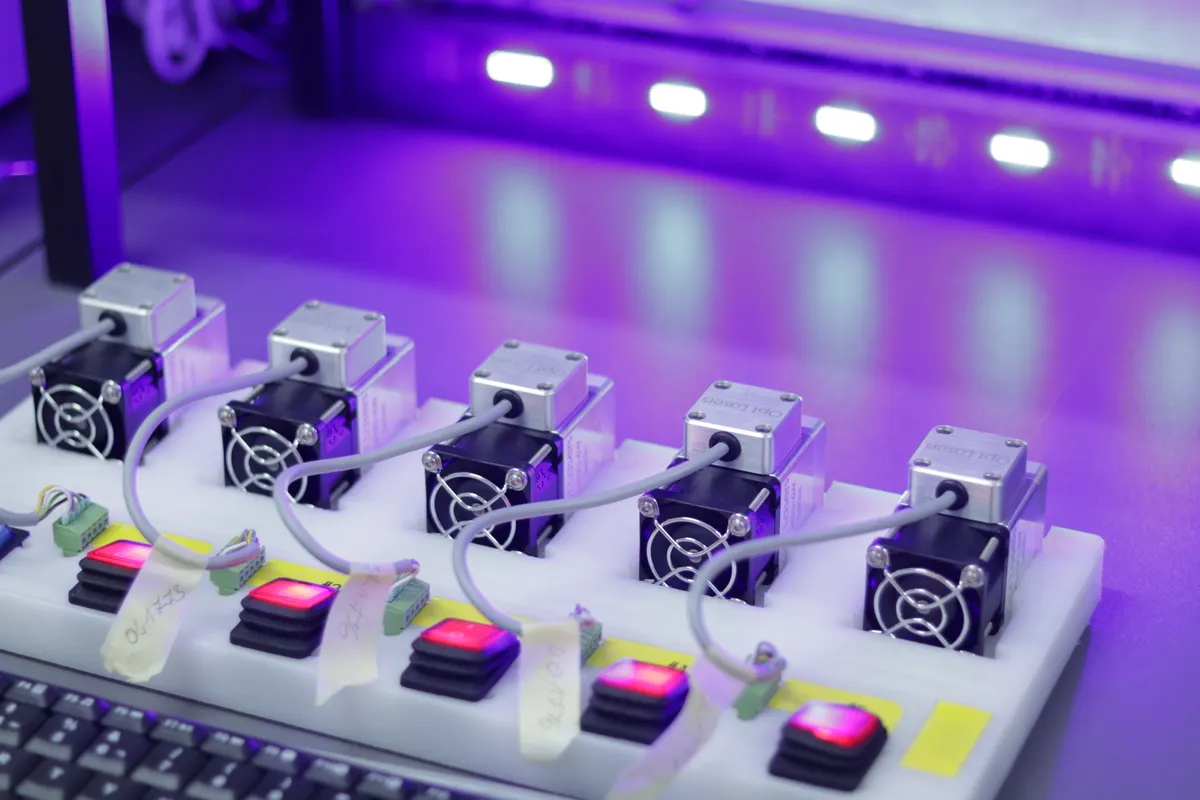
Oratomic emerged from stealth in March 2026, founded by Caltech physicists who had been working on neutral-atom hardware. The platform uses focused laser beams, acting as optical tweezers, to suspend individual neutral atoms in space inside reconfigurable arrays. Unlike superconducting loops or trapped-ion systems that depend on permanent, lithographed physical connections, as the Quantum Computing Report describes it, the atoms themselves become the qubits, held and repositioned dynamically by the lasers.
The approach has a track record, at least in the lab. Caltech co-founder Manuel Endres leads the physics group that, in September 2025, assembled what was at the time the largest qubit array ever built: 6,100 neutral-atom qubits trapped in a laser grid, a result published in the journal Nature. Bluvstein noted that all the core components required for a full-scale machine have already been experimentally demonstrated, if at a slightly smaller scale.
The company is not hedging with intermediate products. Oratomic’s launch announcement states its position directly: ‘We are not pursuing intermediate products or commercial systems along the way.’ No noisy intermediate-scale quantum (NISQ) devices for sale to research teams, no staged commercialisation ladder.
Who Backed the Round, and What the Money Is For
Bezos Expeditions, Index Ventures, General Catalyst, Lowercarbon Capital, and Bain Capital joined the three lead investors. The roster goes further still: Quantum Zeitgeist’s analysis lists Formation 8, Nebular, quantum computing researchers David and Scott Aaronson, Infleqtion, and several other individuals and funds among the participants.
Khosla Ventures founder Vinod Khosla wrote on X that this was his firm’s ‘largest initial investment yet,’ and framed Oratomic as being on its way to solve Shor’s algorithm, the mathematical method that could theoretically break current cryptographic systems. That is a bold public stake to plant at Series A.
FinSMEs reports that Oratomic plans to use the capital for high-performance quantum hardware fabrication, deep algorithmic research and development across fault-tolerant logical qubit topologies, and expanding its physics and hardware engineering teams in Pasadena.
The Comparison Oratomic Does Not Want You to Make
The obvious comparison point is PsiQuantum, valued at $7 billion as of last September, which is also bypassing the NISQ stage entirely and is targeting a million-qubit machine by the end of next year. Bluvstein was direct in rejecting the parallel: Oratomic’s approach is fundamentally simpler and less expensive, he argued, and the qubit count required is orders of magnitude lower.
Whether that claim survives contact with a full-scale build is the question the rest of the decade will answer. The physics worked at 6,100 qubits. Getting to 10,000 in a fault-tolerant configuration, without the error rates ballooning, is a different experiment entirely.
