

The Walt Frazier Finals suits that lit up every broadcast during the Knicks’ 2026 championship run were made in a week by a fifth-generation family business that started life on the Lower East Side over a century ago. You could be forgiven for spending those games watching the wrong person.
The Walt Frazier Finals Suits Behind the Broadcast
For the uninitiated: Walt ‘Clyde’ Frazier is the legendary Knicks point guard who led the team to their only two championships, in 1970 and 1973, before the 2026 title. He retired more than 40 years ago and has been a fixture on Knicks broadcasts ever since, building a second career as a colour commentator with a gift for rhyme: players are ‘dishing and swishing,’ or ‘stumbling and bumbling.’ The suits, though, do a lot of the talking.
Frazier has appeared on broadcasts and in floor seats wearing suits of every stripe, dot, and pattern imaginable. There is the fan-favourite cow-print blazer. There are garments in cheetah, zebra, and python prints, plus plaids, paisleys, and flower jacquards, assembled in combinations that clash so confidently they circle back around to coherent. The site ClydesoFly.com has been grading his outfits on a letter scale since 2013. He does not buy off the rack.
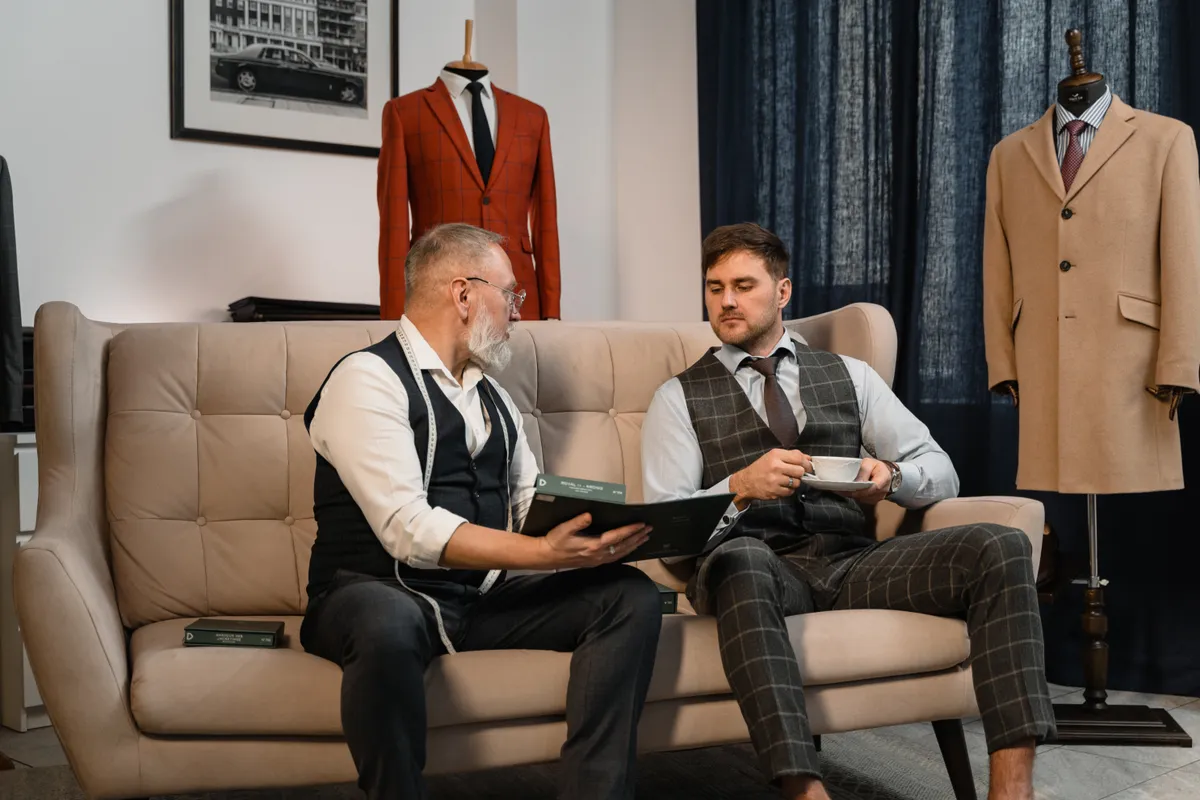
For this Finals run, Frazier wore Knicks-themed orange-and-blue suits throughout, including the floral-patterned blue blazer he wore with a multi-colour tie the night the Knicks clinched the championship in San Antonio. Those were made by Beckenstein Men’s Fabrics, a fifth-generation family firm. After the Knicks eliminated the Philadelphia 76ers in the conference semi-finals, Jonathan Boyarsky (great-grandson of founder Samuel Beckenstein) got the call along with his sons Max and Andrew.
The brief was simple enough: Frazier needed new suits, fast. The Boyarskys assembled a selection of what Jonathan called ‘crazy fabrics,’ including some furniture upholstery, for Frazier to choose from. His favourites were cut and sewn the following day. The day after that, they filmed a Finals hype video for the Knicks. Five suits were completed in roughly a week, with a sixth and seventh held in reserve for potential later games. As it turned out, five was exactly enough.
Neal Boyarsky, Jonathan’s father and the grandson of Samuel Beckenstein, serves as President and CEO of the firm, according to the company’s own website. The firm stocks more than 10,000 fabrics on its first floor alone and holds an exclusive US agency partnership with Scabal of Brussels, one of the trade’s most prestigious fabric manufacturers. That is the infrastructure behind what looked, on television, like a very good week of dressing.
A Shop That Started With a Pushcart
The Beckenstein story is its own kind of New York fable. Samuel Beckenstein began by selling rags by the pound from a pushcart on Orchard Street, according to Time Out New York. That eventually became a proper shop, opened in 1919 on the same street. The business stayed rooted in the Lower East Side for decades before relocating to the Garment District in Midtown Manhattan in 2003, as Ephemeral New York has documented. The original Orchard Street premises were sold and converted into a luxury rental block.
The fabric Frazier’s suits are cut from largely comes from shops in the Garment District and the Lower East Side, which means the supply chain for his more outrageous choices runs through the same few streets where New York’s schmatta trade has operated for generations. There is something satisfying about that loop.
Frazier became a fashion presence long before the broadcast career. Playing for the Knicks, he was already known for turtlenecks, oversized fur coats, capes, gold chains, and a wide-brimmed hat that earned him the nickname ‘Clyde,’ his teammates reckoning it belonged to the 1967 film Bonnie and Clyde. He drove around Manhattan in a Rolls-Royce. Today, every player has a stylist and a tunnel-walk strategy. Back then, players were not even paid to wear trainers.
Frazier changed that. According to The Word on the Feet, he was the first NBA player in history to have his own signature shoe. The Puma Clyde, released in 1973, went on to become a cult item in skate and hip-hop communities, per Baller Shoes DB. Puma then signed Frazier to a lifetime endorsement deal in 2018, coinciding with the brand’s return to performance basketball.
The suits are custom, the tailor is a century old, and the fabric sometimes used to be someone’s sofa. When the Knicks open their title defence next season, the only real question is what Frazier wears to the ring ceremony.
