

The Mecka AI Sequoia round is shaping up to value the New York-based robot-training startup at around $500 million, according to two people with knowledge of the deal, quite the leap for a company that only formally incorporated in 2025.
Sequoia Capital is leading the new financing, though the precise size has not been disclosed and the terms are not yet final. Neither Mecka AI nor Sequoia Capital responded to requests for comment.
The timing is what makes you do a double-take. The deal comes roughly three months after Mecka closed a $60 million raise led by Framework Ventures, with participation from Menlo Ventures, SV Angel, and Kindred Ventures. That $60 million round was itself structured in two tranches: a $25 million Series A closed in November and a $35 million follow-on, according to Fortune. Angel investor Ted Xiao, a former Google DeepMind researcher and founding member of Jeff Bezos’s AI venture Project Prometheus, also participated in that round.
Signed Contracts, Not a Pipeline Deck
When Mecka announced the $60 million raise, chief executive Josh Gao told Fortune the company was projecting a $100 million annual run rate by the end of 2026. The headline figure was already eyebrow-raising; the detail beneath it is the more interesting part. Fortune reports that the projection is based on already-signed contracts, not forecasted pipeline, though Gao declined to name any customers. Robotics companies and AI labs are, it turns out, willing to pay for the physical-world data they cannot easily manufacture themselves.
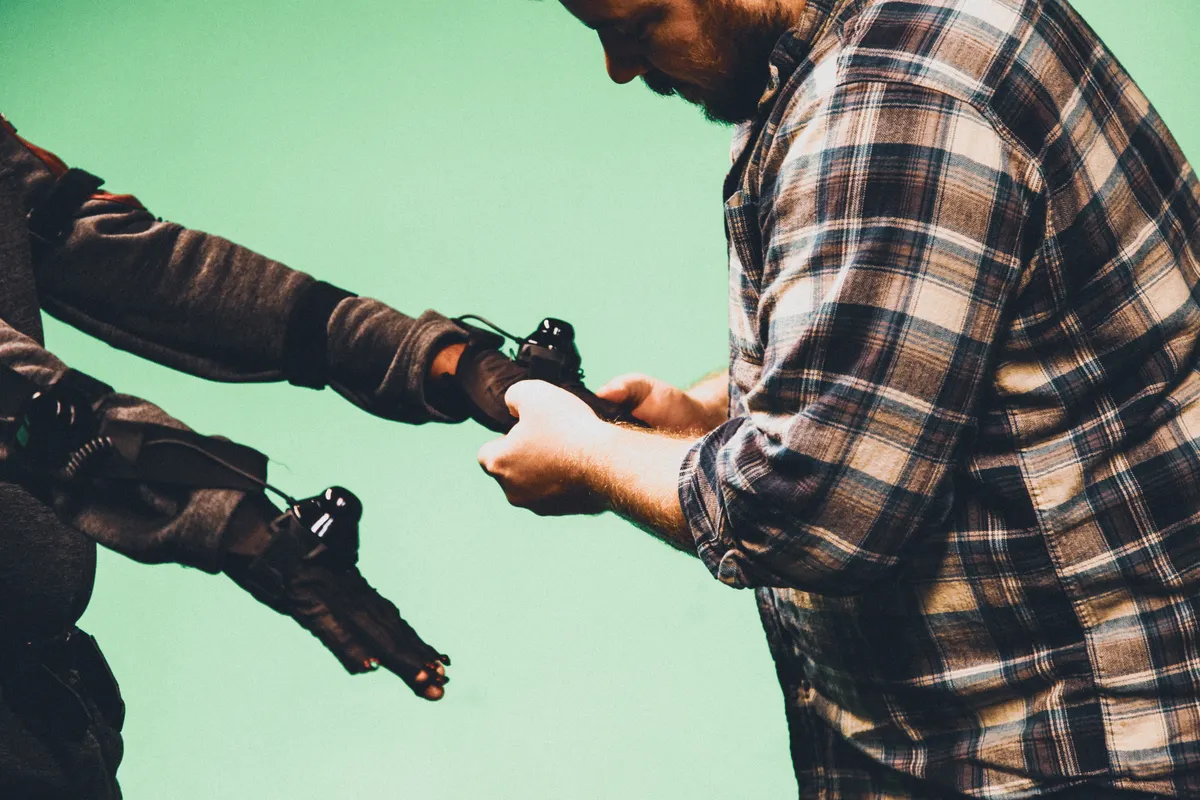
That data gap is Mecka’s whole pitch. The startup pays people to record themselves performing everyday tasks (making coffee, fixing cars, general household work) using body sensors and smartphones. The approach of training robots on real human movement rather than teleoperation had, per Dealroom, mostly existed in research papers until Gao’s team partnered with robotics labs to prove it could scale. The four co-founders spent months studying robotics research before formally incorporating in 2025, having begun data collection activities a year earlier in 2024.
Four Founders, Zero Robotics Backgrounds
Mecka’s founding team is, charitably, unconventional for a robotics-adjacent company. Canadians Josh Gao and Mogen Cheng previously built a restaurant payments startup, which they sold in 2023. Jason Chong joined Coinbase after it acquired his crypto exchange. Duy Nguyen, the team’s operations lead and its only non-Canadian, previously made his money flipping trainers as a self-described sneakerhead, according to Fortune. None of the four came up through robotics.
Their bet was not that they understood robots, but that they understood the data problem. Mecka’s name derives from “mecha,” the fictional genre of human-piloted giant robots, and the company’s stated ambition is to do for robotics what Scale AI, Mercor, and Surge have done for large language models: turn the messy work of human data labelling into a scalable commercial operation.
Framework Ventures, which led the Series A, has been moving in this direction across its portfolio. The firm raised a $400 million fourth fund as it expanded into robotics and AI, according to its Framework Ventures newsroom.
The Mecka AI Sequoia Round in a Crowded Field
Mecka is not alone in this market, and the competition is moving fast. XDOF, a rival robot-training data startup, came out of stealth on 17 June 2026 after closing a $70 million Series A, and by early September was already in talks for a Series B at a $1.2 billion valuation, led by 8VC. The catalyst, per TechCrunch, was annualised revenue approaching $50 million that prompted investors to approach XDOF before it had planned to raise again. XDOF is also partnering with UC Berkeley’s AI Research lab to release what it calls the largest collection of high-quality robot training data ever assembled, a combined teleoperation-and-sensor dataset it has dubbed “ABC”.
The pattern here is consistent: investors are willing to move quickly and at steep multiples because the underlying constraint, a shortage of physical-world training data, is real and not easily solved by incumbents. Whether Mecka’s $500 million price tag holds once terms are finalised is another question entirely. The deal is not done yet.
