
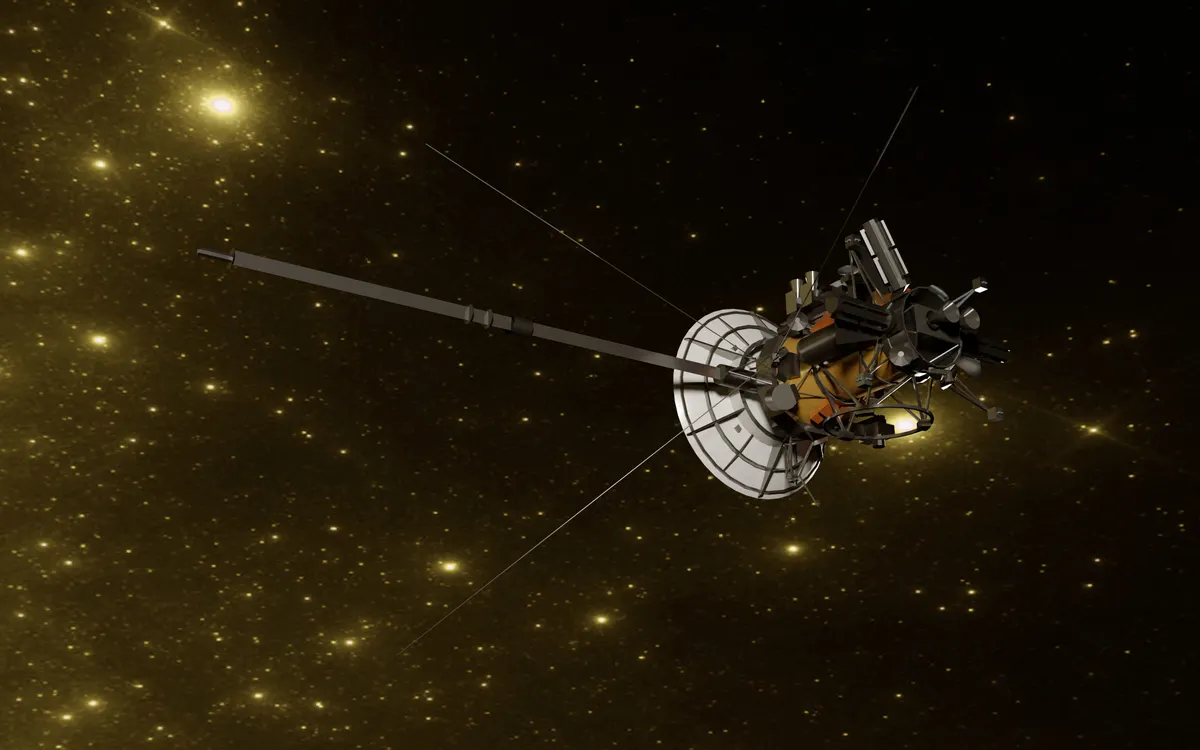

The Fermi Explorer interstellar mission has emerged from the founders of orbital computing startup Starcloud with a plan that is, by design, slower than any space programme in history: send a one-kilogram spacecraft toward Alpha Centauri and accept that it will take roughly 80,000 years to get there.
The non-profit launched publicly this week to solicit partners, funding, and scientific or artistic payloads. The core team is Philip Johnston, Adi Oltean, and Ezra Feilden (all Starcloud co-founders), plus programme manager Garret Jameson. Johnston serves as president of the Fermi Explorer organisation, according to GeekWire.
The mission budget is $15 million, with a target launch in 2029. The payload: a 10 cm square package weighing 1 kilogram, carried on a rocket rideshare, then manoeuvred by electric propulsion through a series of gravitational slingshots until it escapes the solar system and coasts toward the nearest star. The spacecraft is expected to remain active for about 12 years before entering that final coast phase.
Why the Fermi Explorer Interstellar Mission Is Betting on Slow
Alpha Centauri sits 41 trillion km from Earth. Voyager, launched in 1977, has covered roughly 26 billion km since then. The gap between those two numbers is precisely the problem that has stalled every previous interstellar proposal, and Johnston’s answer to it is to stop treating speed as the variable worth optimising.
‘The big difference with most other [interstellar] missions and the Fermi Explorer is that the others all try to do it in a human lifetime, which means billion-dollar propulsion R&D programs. We have very deliberately picked 80,000 years as the minimum viable mission,’ Johnston said.
Johnston does not expect his probe to win the race. He told GeekWire he anticipates that human descendants will develop faster travel methods long before the year 82026, and delivered the obvious punchline with admirable composure: ‘We’ll be the first to leave, and the last to arrive.’
On durability, he is similarly relaxed. ‘If a dinosaur bone can last 200 million years then a metal box can easily survive the radiation environment we expect for 50,000 years. We don’t plan on powering spacecraft up at the end of the 80,000 years. We hope that a future human civilization will intercept it.’
One conceptual motivation, reported by CNET, is the Fermi Great Filter: the idea that some barrier so hard to cross means intelligent life rarely survives long enough to be detectable. Sending even a passive probe tests the proposition that a civilisation can, in fact, persist and plan across geological timescales.
What Happened to the Last Interstellar Attempt
Fermi Explorer is positioning itself explicitly as the affordable alternative to Breakthrough Starshot, the programme launched in 2016 by Yuri Milner, with Mark Zuckerberg among its backers. Starshot planned to fire gram-scale nanocrafts fitted with light sails to 20 per cent of the speed of light, reaching Alpha Centauri within roughly 20 years of launch. Initial funding stood at $100 million; Milner later put the full mission cost at $5 to $10 billion, with a first launch estimated around 2036.
It never got there. Scientific American has reported that Starshot wound down gradually rather than with a single announced closure, with its associated Breakthrough Discuss meetings continuing through 2025 (minus 2020, and virtual in 2021) before going quiet.
‘I also got excited and then disappointed!’ Johnston said of Starshot. ‘That’s the reason we are doing the mission. We are hell-bent on actually launching something in three years.’
The group is in talks with NASA, though Johnston told GeekWire that NASA ‘has a very long process for backing missions.’ At $15 million, Fermi Explorer does not need NASA to say yes quickly.
The Starcloud Connection, and Where It Stops
The shared founding team inevitably raises the question of whether this is a brand exercise for Starcloud. Johnston has said explicitly that there is no operational overlap between the two organisations.
Starcloud itself has had a busy few months of its own. The Redmond, Washington-based company, founded in 2024, placed the first Nvidia H100 GPU in orbit in November 2025 and subsequently trained Google’s Gemma AI model from space, the first AI model trained in orbit, according to CNBC. The company claims its orbital data centres run at 10 times lower energy costs than terrestrial equivalents, powered by uninterrupted solar exposure.
In August 2026, Via Satellite reported that Starcloud added $250 million to its Series A round, lifting its valuation to $2.3 billion. Total funds raised reached $450 million. The long-term ambition, per the company’s own disclosures, is an 88,000-satellite constellation delivering 20 gigawatts of orbital compute.
So the founding team is simultaneously building one of the more audacious commercial space infrastructure plays on record and a non-profit designed to take 80 millennia to complete its primary objective. If the Fermi Explorer interstellar mission does launch in 2029, the spacecraft will outlast Starcloud’s own satellites (expected five-year lifespans, per CNBC) by a cosmological margin. Whether that counts as a hedge or just an interesting Tuesday is left as an exercise for the investors.
