

Fusion startups are chasing defence deals with renewed urgency, and two recent announcements suggest the sector’s national security pivot is accelerating well beyond opportunistic sidelines.
The backdrop is familiar. Climate-tech venture funding has stalled, and fusion is an expensive business. When defence budgets start looking like a complementary revenue stream, portfolio companies and their backers tend to notice quickly.
Xcimer and RTX: Lasers Built for Power Plants, Wanted for War
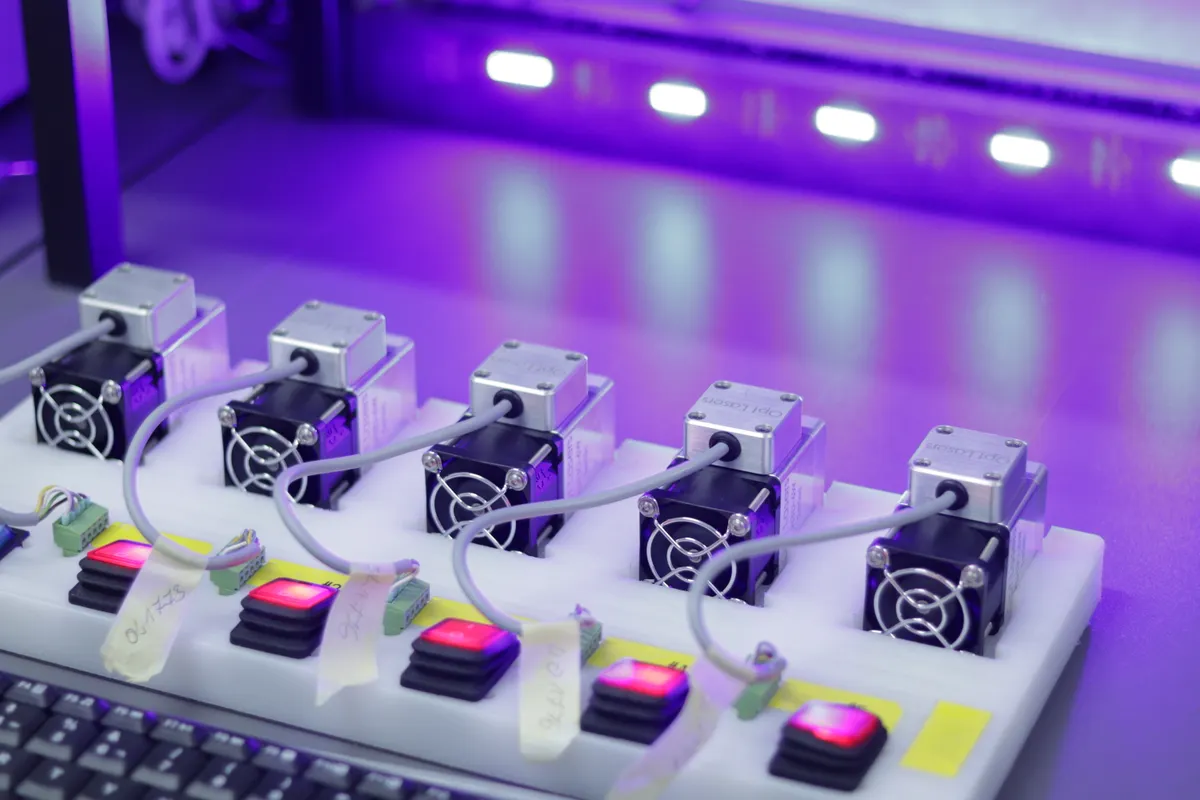
Denver-based Xcimer Energy has announced a partnership and investment from RTX, the conglomerate that includes defence contractor Raytheon. Under the deal, RTX Ventures provides funding while the two companies have signed a teaming agreement to explore integrating and containerising Xcimer’s pulsed-laser technologies into RTX’s defence systems, specifically targeting development of scalable multi-kilojoule-class pulsed-laser capabilities.
Xcimer CEO Conner Galloway said the company’s excimer-based laser technology offers performance, speed, and inherent scalability ‘at a fraction of the cost and complexity of today’s systems,’ and that the RTX investment will help accelerate development of directed energy capabilities to defeat airborne threats.
The timing is not accidental. Drones have reshaped modern air defence economics in ways that make laser weapons suddenly very attractive. A decade ago, a US ally used a $3 million Patriot missile to shoot down a $200 consumer drone. Effective, yes. A viable long-term strategy, no. Laser weapons change the cost equation: they fire repeatedly using electricity from a generator or ship reactor rather than burning through expensive single-use munitions.
Xcimer’s current laser system, Phoenix, is already powerful enough to have caught the defence industry’s attention, even though it operates at roughly an order of magnitude below the power level required for a commercial fusion power plant. The fusion application and the weapons application, it turns out, need very similar underlying hardware.
The company is not short of backers on the civilian side either. Xcimer has raised more than $150 million from investors including Breakthrough Energy Ventures, Lowercarbon Capital, Emerson Collective, and Prelude Ventures, and won the largest laser fusion award from the Department of Energy’s Milestone-Based Fusion Development Program. The DOE has since awarded Xcimer a further $30.5 million from that programme, according to an Xcimer press release dated 5 October 2026. The company has also received a $4 million ARPA-E award to improve the efficiency of high-power excimer lasers, working alongside Texas A&M University and the US Naval Research Laboratory.
Xcimer’s stated commercial timeline targets fusion energy on the grid by the mid-2030s. The RTX relationship suggests it will have a parallel revenue line well before that.
Pacific Fusion Brings Fusion Startups’ Defence Deals Into New Mexico
Pacific Fusion is pursuing a different but equally deliberate path. The company recently broke ground on its Research and Manufacturing Campus and Demonstration System in Albuquerque, New Mexico, close to the Sandia and Los Alamos National Laboratories. The project is described as a $1 billion-scale investment and is positioned as an anchor for a US fusion industry hub in the state.
Alongside the groundbreaking, the National Nuclear Security Administration (NNSA) and Pacific Fusion signed a memorandum of understanding. The MOU, signed by NNSA Administrator Brandon Williams and Pacific Fusion co-founder and CTO Keith LeChien, establishes a framework for collaboration on high-yield fusion, high-energy-density science, pulsed-power technologies, advanced materials, and modelling and simulation. Any specific projects or funding commitments remain subject to separate agreements.
The facility’s primary purpose is to demonstrate net facility gain, what Pacific Fusion describes as the world’s first high-yield fusion system of its kind. But LeChien was candid about the dual-use potential: ‘It turns out that the facility that we’re building also has utility in this world-leading defence application.’
Co-founder and COO Carrie von Muench was blunter still. Defence applications were ‘always on our mind.’ LeChien previously worked at Sandia National Laboratories, Lawrence Livermore National Laboratory, and the NNSA before co-founding Pacific Fusion, so the government relationship is baked into the company’s DNA, not retrofitted onto it.
For context on where the underlying science stands: the National Ignition Facility, which has supported national security applications for more than 25 years, achieved first ignition in December 2022. Lawrence Livermore’s laser fusion programme then set a record fusion yield of 8.6 MJ with a target gain greater than 4 in April 2025. That is the benchmark these startups are chasing commercially, and the same physics that makes it interesting to grid operators makes it interesting to weapons developers.
The defence pivot among fusion startups is less a pivot than a homecoming. The DOE’s next milestone review for Xcimer’s Athena power plant architecture will be a useful indicator of how fast the civilian and military timelines are converging.
